This is why?
Just stumbled across this beautiful video of the Mariña coastline, the nearest coast to the house, and thought I’d share it with you.
It does have sound…just in case you are at work!
[youtube n0jUEqEKug0 nolink]
This is why?
Just stumbled across this beautiful video of the Mariña coastline, the nearest coast to the house, and thought I’d share it with you.
It does have sound…just in case you are at work!
[youtube n0jUEqEKug0 nolink]
Do you remember me suggesting in early February that our planning application for the conversion of the small house into our small dwelling was finally ready to be submitted for the consideration, deliberation and rumination of Pontenova Concello?
Well, it appears that I may have somewhat jumped the gun.
At the end of February we sent back the ‘duly signed’ forms and the architect, who cannot be named, confirmed that she had them. Then everything went quiet and we foolishly assumed that the wheels of bureaucracy had been set in motion on our behalf.
Then yesterday, out of the blue, arrived a seven megabyte e-mail from the architect which I optimistically tried to download onto my iPhone while sat in stationary traffic on the M62. After killing my fellow struggling commuters 3G connections for a good twenty minutes I gave up, resigned to wonder at the contents until I got home.
Once back in the land of broadband, what awaited me was a mass of documents of all shapes and sizes which apparently comprise our application, and which is now on the verge of being submitted…no really!
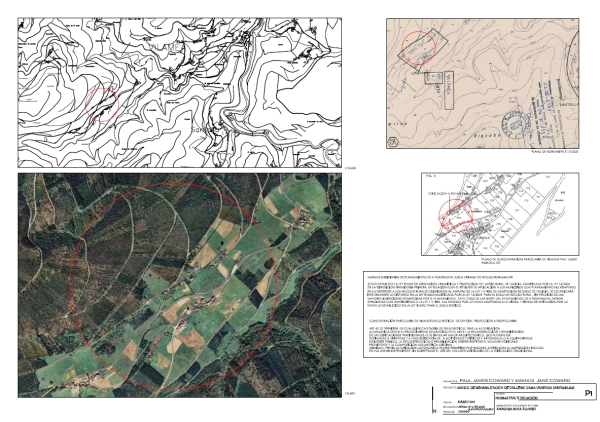
One of twenty pages of Galician Planning Application
It appears from the accompanying e-mail that our architect has been waiting to include the ownership documents from our gestoria in Ribadeo. Who in turn was waiting for them from the Spanish equivalent of the Land Registry. Who themselves have been trying, seemingly unsuccessfully, to register us as the new owners of Casa Liñeiras ever since we signed on the dotted line in the, friendly but smokey, Notarios office back on the 21st June last year (ten months and counting).
In the end the architect has given up and decided to take a chance and submitted the application without the ownership proof in the hope that it will arrive soon and she can sneak it into the application bundle before it starts its magical bureaucratic mystery tour around Galicia.
Amanda and I, well mostly Amanda, then spent an hour trying to understand what the extensive documentation was all about before giving up and looking at the plans and a new set of pretty photographs which the architect had taken (she’s earning her money on this one). Satisfied that such an extensive bundle of paper must mean that the architect knows what she is doing, we emailed back our blessing.
And that is just for the small house, imagine what a palaver it is going to be for the casa rural when we get around to it. Perhaps we should start now!
You could be forgiven for thinking that we have an unhealthy fixation with low cost airlines. When you make frequent journeys to Galicia and Asturias then EasyJet and Ryanair become friends whose status you check more often than your nearest and dearest on Facebook.
I was then somewhat startled then a colleague drew my attention to some EasyJet news which had passed me by, and which then had me rushing to the EasyJet booking pages, google maps, and the Autopista de Espana to look at all the possibilities.
What caused such excitement?
Simple really…EasyJet have just announced a thrice weekly summer months flight from Manchester to Bilbao, probably to test the market viability of the route. While Bilbao is miles away from the house this still gives us a real dilemma, as it opens up a viable alternative for us. At the moment our only real options are;
This new route now gives us the option of;
Factor in that there are no tolls on the section of Autopista from Bilbao to the house, fuel is currently about 20% cheaper in Spain than here, we’d be putting the miles and depreciation on a hire car, and that the Spanish roads are a joy to drive outside the fiestas, and it makes the thirty minutes extra total drive time a negligible factor.
The Spanish reducing the Autopista speed limit from 120kmh to 110kmh is a bit of a disappointment, but that will only be felt if they actually decide to enforce it, which is a big ‘IF’.
Next time we go (after the route starts in mid-June) then we’ll take a serious look at this as an option.
So nice one EasyJet, and thanks for the pleasant dilemma.
It was the Moors who introduced the tradition of the horno (pronounced or, no) to the Iberian Peninsula and one which Galicia embraced with both arms. Almost every property that we saw while seeking out our ideal casa had one, and they came in a whole variety of shapes and sizes.
The traditional Galician Horno is usually attached as a single storey, stone built, slate or stone-roofed, semi-circular building to the side of a house, and they are not too hard to spot. The one pictured on the left below was attached to the Rectory House which was my ‘first love’, as the first house we visited, on our very first trip to Galicia, and which Amanda very sensibly talked me out of as a ‘terminal money pit’.
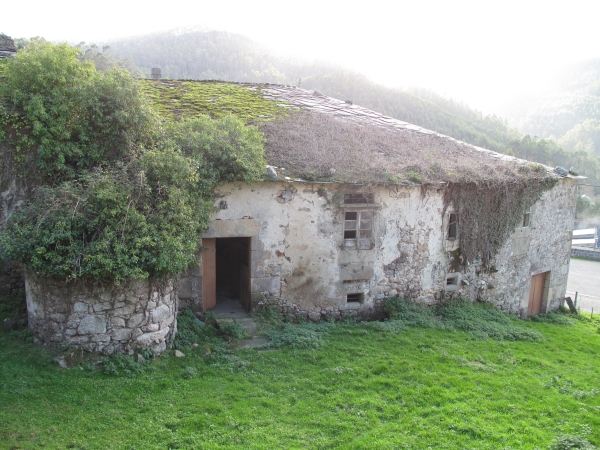
The Rectory Horno
These Horno have a waist height small opening to the inside of the house, often in the kitchen, with a metal door which latches shut to keep the heat in. To use them you light a fire inside which you let burn for three to four hours before raking out the embers leaving a stone cooking surface and a domed oven which will retain cooking temperature heat for twenty-four to forty-eight hours.
You can then use the oven to cook whatever takes your fancy, although this will almost exclusively be bread, and the occasional suckling pig. Once the oven has cooled you then start the process all over again.
These ovens make great features in main houses, ad many are restored to working condition like this one that we found in a house near As Pontes. It was the only part of the house that had been restored, apart from the roof, and was used by the owners family when they visited for picnics and nights camping on the 22 acres that comprised the property.
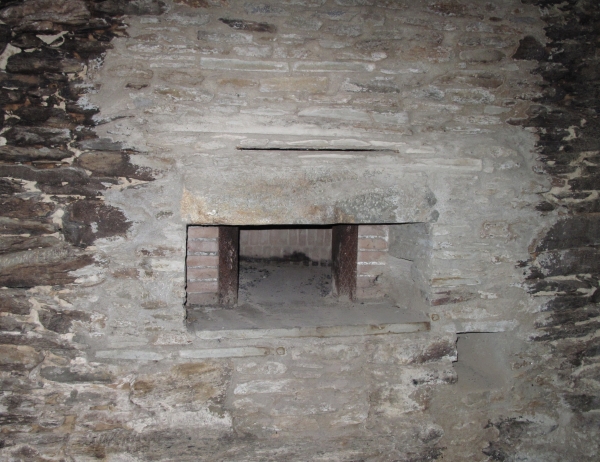
As Pontes restored horno
Here is one ripe for restoration which was inside a property in the south of Galicia, near Tui. All it needs is a good sand/water blast to remove the bulk of the soot and small child to send in there to give it a good sweep out, and it would be ready to work again.
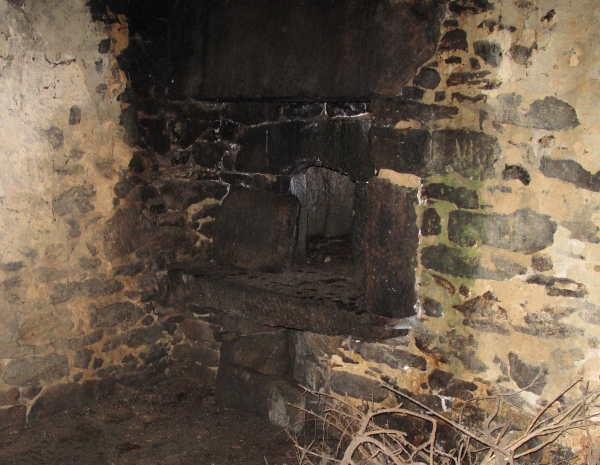
Horno near Tui
Occasionally you get to see the Rolls Royce of horno, one which is attached to an open cooking fire, a lareira (as I have been informed it is spelt). Here a central fire is used to cook in big pots, with smoke and smells going up the large chimney, with the oven behind. The bench seats are where the family would sit to keep warm in winter and eat there meals. There can be few things more romantic, if you can see past the stark wooden benches.
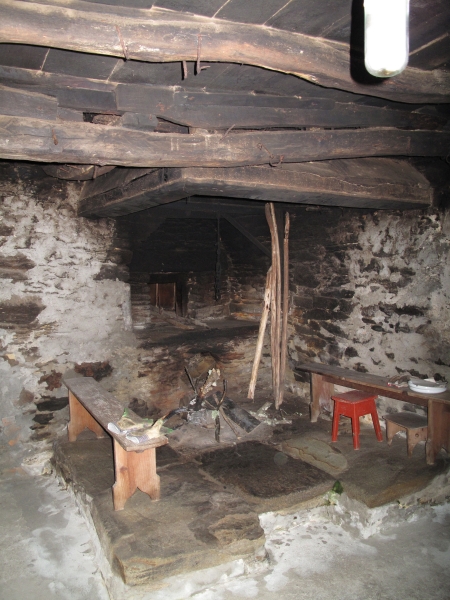
Horno near Ortigueira
What about Casa Liñeiras? I hear you ask.
Well…we have an horno too (in theory) and ours is in a separate building to the main house. This is a supposed mark of prestige and importance of the house, as it means that the casa de horno would be available to the villagers to make and bake their bread.
I say ‘in theory’ as we haven’t yet seen inside our horno. The roof of the house has caved in and there is stone behind the only entrance door blocking our ingress. We haven’t wanted to force it open as we’d have no means of then securing it.
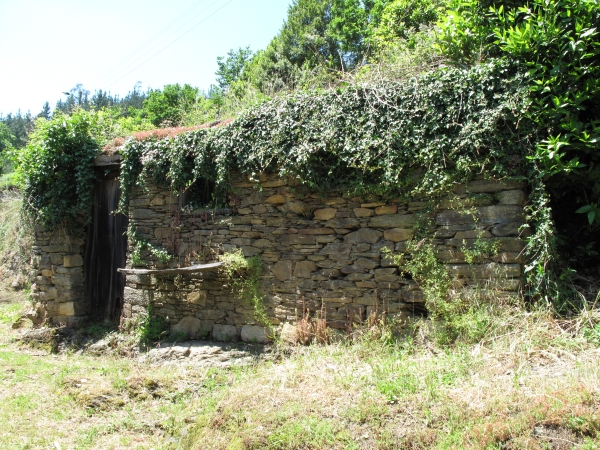
Our horno from the front
This little house is pretty substantial, some twenty square metres with a single door and small window above an ancient shelf which we assume was used to hold baskets of dough for proving prior to baking. In the far left corner is where we believe that the oven is, cut into the stone of the hillside and with a long vanished chimney at ankle height as you stand on the road above.
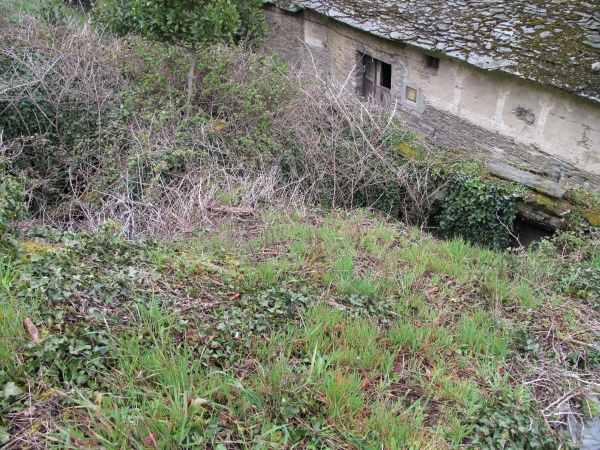
Our horno from above
The area in the foreground is where we believe the oven to be and the rest of the room would have been for preparing and cooling the bread. This little house is one which I hope to renovate myself once I have spent many hours spying on the builders and their techniques. We intend to restore it to a fully functioning bread oven, and who knows, if you visit us in a couple of years time you may wish to try your hand at baking your own breakfast?
What could be more satisfying?
The architect who can’t be named e-mailed through the ‘final’ (fingers crossed) papers for us to sign and send back via snail mail to enable the submission of the planning application for the small barn.
These were; a three page document in gallego (licenza urbanistica) confirming that we own the land and are submitting the application with all the correct documentation; the second, in castilian, was a one pager in which we were agreeing not to inhabit the house until all services were laid-in, and that we’d be responsible for any damage caused to the local infrastructure by, and during, connection.
I opted to send the documents by ‘International Signed-for’ at £4.95 to ensure that they hit their destination. They went on Monday with the suggestion that it was likely to take four days so I logged on to the tracking today to check its arrival to be given the message;
‘Your item, posted on 28/02/11 with reference RI**********GB has been passed to the overseas postal service for delivery in SPAIN AND CANARY ISLANDS.’
which I interpret as the Royal Mail saying, ‘We’ve managed to get it as far as Spain, we’ve washed our hands of it, now it is in the lap of the Gods’. I’d better e-mail the architect to see if it has arrived!
As we’ve currently hit the development doldrums while waiting for the Spanish authorities to do their stuff, I thought I’d go through the many photos that we’ve taken on the eight trips we’ve so far made to Galicia. In doing so I spotted a worrying trend…we’re breeding washing machines!
When we bought the house back in June 2010 there was a single old washing machine in a partitioned corner of the house. We considered it ‘one of those things’ that came with the house and that we’d eventually have to pay for the disposal of.
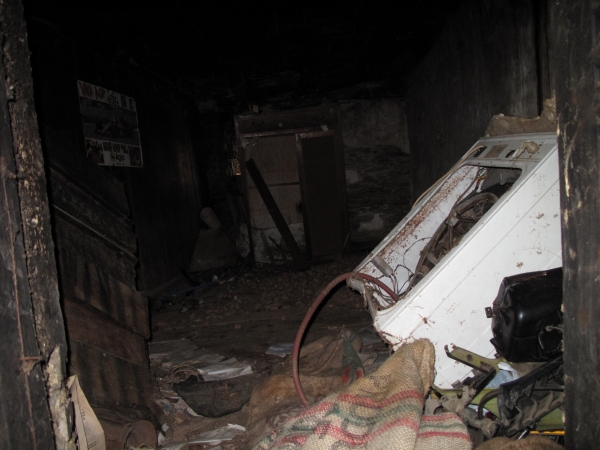
Back in June - just the one
Examining the photos from January this year, the solitary discarded washing machine had turned into two.
Surely this can’t be normal?
Can washing machines breed in dark wet rooms, or have we been the victims of a bizarre form of reverse Galician fly tipping?
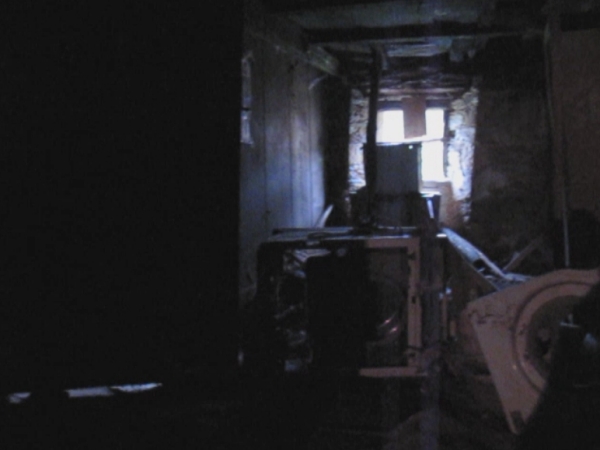
And then there were two
Despite numerous conversations with locals and other Brits, we’ve still not determined how you get rid of unwanted white goods in Spain. The norm seems to be to either leave them outside until they rust to dust, or dig a big hole and bury them, as there are no municipal dumps or recycling centres.
I can see these, and any further mechanical children that they have before we clear the house, making the long journey back to England and causing consternation and amusement at our local ‘tip’ in Huddersfield with their two pin plugs and Spanish decals.