Ribadeo, our gateway to the coast

As we await a couple of pieces of important news about the house, which I will of course share with you in due course, I thought I’d blog about Ribadeo.

Although mentioned previously in passing, I’ve not focused on our nearest coastal town.

Sitting at the north-east extreme of Galicia, the province of Lugo, and the area of A Mariña Oriental it is the hub of the local area and in the 2006 census it had a population of just under 10,000.  Slap bang on the coast it is thirty minutes from our house and the gateway to at least half a dozen delightful beaches and coves as well as having a number of good restaurants, and a couple of big supermarkets as well as many specialist shops.

[mediaplayer src=’/sadfish/visitgalicia//Ribadeo.wmv’ ]

The main square sits in front of the town hall and while small, it is pleasant enough with trees, grassed areas and a small children’s play park and surrounded by building acts as a summer sun trap. It’s also on the pilgrim route (Northern Route) so the ‘scallop shells’ can be followed, for a short distance at least.
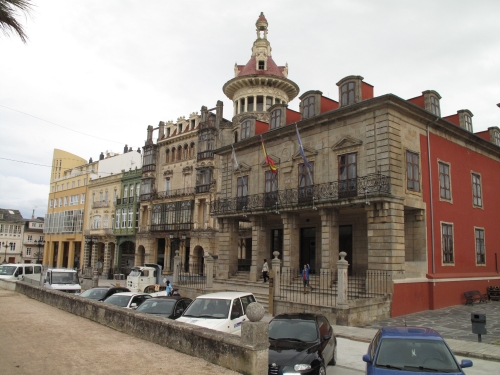
Town Hall

Right in front of the town hall is a bust which was donated by the people of Montevideo (Uruguay) in 1957 to celebrate the centenary of the birth of renowned author and poet ‘El Viejo Pancho’ (José Alonso y Trelles) who was born in Ribadeo (although some contest he was born just over the Asturian border in Castropol, Asturias) before emigrating to South America at the age of seventeen.
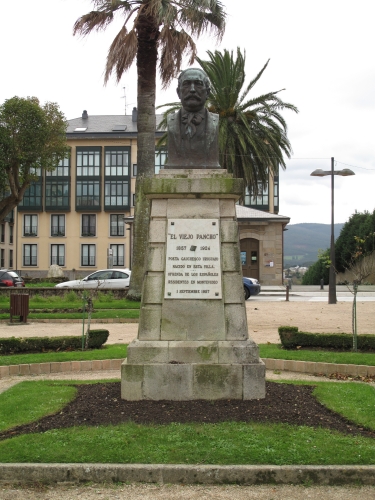
El Viejo Pancho

Ribadeo has an association with the world famous Sargadelos ceramics. The founder, Antonio Raimundo Ibáñez (Marqués de Sargadelos), used Ribadeo as his main port for exporting from the manufacturing base in Cervo, Lugo (50km along the coast towards A Coruña).  A nice little story until you learn the macabre fact that during the Spanish War of Independence (in 1809) Ibáñez, unfairly accused of collaborating with the French enemy, was assassinated by being dragged through Ribadeo’s streets behind two horses.

The town has two museums (the San Damián Fort and Casa da Ría, Nature Centre) and nine monuments as well as a pretty little marina where hundreds of white pleasure craft bob about on the Atlantic Ocean.

But saving the best until last, Ribadeo also has a number of good restaurants to tickle your taste buds. The best of these, despite its appearance, always has a queue for tables and serves a selection of freshly caught and traditionally cooked seafood.
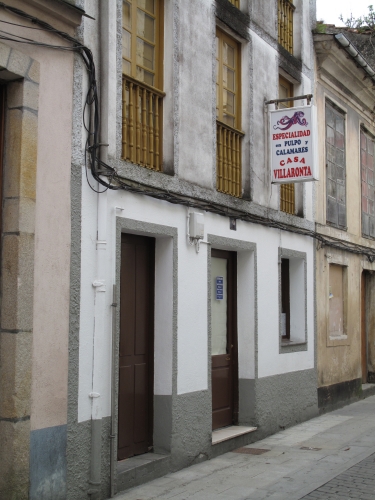
Casa Villaronto

We ate here with Ramon the night before we finally bought our house, and the pulpo (octopus) and chipirones (squid) were exquisite and washed down with local white wine served in small ceramic bowls from a ceramic pitcher (you’re right, they could have been serving us anything).
Posted in Food & Drink, Local Life, Places to Visit | Tagged , , | Leave a comment

Northern Spain is not just for summer

Popular rumour would have you believe that northern Spain is only fit for visiting from the start of July until the middle of September. Those expounding this tattle would suggest that outside the Galician summer it is wet, windy and closed, just like Whitby on soggy November Wednesday. However, if our visit from the 12th to 15th January is anything to go by, the winter is the perfect time to avoid the crowds and more-or-less have the place to yourselves.

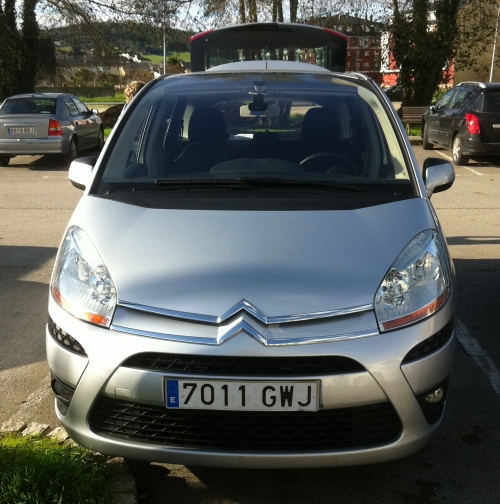
The first benefit which we gained from such an unseasonal visit, apart from a pretty empty EasyJet flight with plenty of room to spread out, was a big bonus at the Atesa car hire desk. We’d booked a ‘compact two-door a/c’ expecting the usual Seat Ibiza or Citroen C2 but for just £17 a day (all inclusive) we were given the keys to an upgraded Citroen C4 Picasso (which should have been £50 a day)…. one with iPhone music and phone bluetooth connection…. and everything! Climbing aboard this big bus I instantly knew it was going to be a good few days.

The upgraded chariot

The sun was shining, the temperatures pushing twenty degrees centigrade, and the roads were traffic free. House business took up our Wednesday and Thursday, but on friday we hit the tourist trail and headed for a night in Gijon (pronounced Hi-Hon as though you are clearing your throat at the start of each syllable). We were booked into the Silken Hotel Ciudad Gijon at 60€ per night for the room, a modern hotel (opened 2006) which is a pleasant 10 minute walk from the old town.

Gijon is the second city in Asturias although its inhabitants feel as though they should be the capital, ahead of Oviedo. As Gijon is on the coast, those living in Oviedo often refer to it as ‘our port’ further riling the Gijonese. But don’t be so quick to dismiss it.

Although it is a largely industrial area the new and old town are very clean and very pleasant and there are two massive beaches which sported surfers and swimmers, even in the middle of January. I didn’t trouble my toes with the sand, let alone the crashing and bubbling Atlantic Ocean.

On friday evening we found a brilliant sidreria in the old town (the area called Cimadevilla) which is the settlement between two beaches on the peninsula. Originally a roman settlement it contains nice squares, old buildings and narrow streets. At its heart is Plaza Mayor where, in one corner, you can find El Centenario (The Centenary), the chosen target of our high gastronomic expectations.

Fantastic tapas

After waiting half an hour in what can only be described as a rugby scrum for a table we got one sat right on the side of Plaza Mayor watching the world go by and ordered sidra (which turned out to be even more like paint-stripper than that I’d had in Oviedo) and tapas. It was approaching midnight, we were in shirt-sleeves (well I was, Amanda had her coat on as usual) and all was well with the world as some of the best tapas that we’ve had arrived to tickle our taste buds.

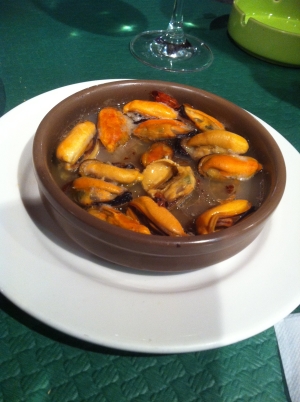
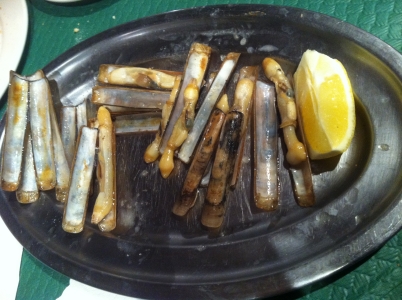
We’d ordered, the ubiquitous chipirones (fried baby squid), mejillones con ajo(mussels with garlic) and a sensational plate of navajas a la plancha (razor clams). All three dishes were fabulous, washed down with cider (poured from a great height) and followed by a plate of Asturian goats cheese (not pictured here as the cider had taken effect and I forgot).

Superb chipirones

Succulent mejillones

Sensational navajas

Northern Spain is therefore not just for summer. It is an experience that changes with the seasons and which can be enjoyed all year round.

Posted in Food & Drink, Local Life, Places to Visit | Tagged , , , , | Leave a comment

Stumbling over the marathon start line

It happened just a few days short of seven months since we had sat nervously in the smoky Notaries office and heard her speed talk through what we were buying, before we handed over most of our life savings and took delivery of the symbolic key for 13 Liñeiras. Ever since then it feels like we’ve been limbering up for the big race, taking on fluids, and occasionally stretching our Lycra covered muscles. But for almost seven long months we’ve not even managed to get over the start line on our mammoth renovation marathon.

But last week all that changed. Our architect, the one we cannot name, submitted our plans for ‘Obras Menores’ (minor works) on the small house and the horreo. We’ve applied for these licenses to allow us ‘repair’ the roofs of these two structures and to make them watertight. This work also includes lining the roof of the small house with chestnut and installing insulation and a weatherproof membrane in readiness for later conversion to a house.

The application takes the form of plans, pages of words in Castilian and Gallego and an estimate from a local builder of the likely costs. If granted, and there shouldn’t be a problem (everything crossed and wood touched), then we will pay taxes equivalent to 3% of the quoted price. This would then allow us to begin work.

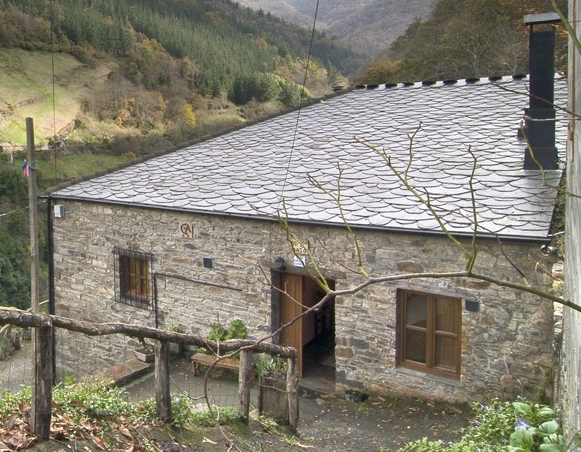
Should we find, on attempting the repair, that new slates and some timbers are required then we are allowed to also do this under the ‘Obras Menores’ license. Should this be the case then we have asked our builder to use a beautiful irregular slate pattern, and to create the ridge using traditional interlocking tiles just like out friend Pepe has done at his peaceful little hamlet of self-catering houses at Teixois, just over the border near Taramundi.

http://www.casasdealdeateixois.com/

A ridge formed in this way is reputed to be more watertight than traditional ridge tiles and it certainly looks much better and will replicate the current style of roof on our house. It is a little bit more expensive, according to our builder, but we think it is worth it.

The application is now on its way to the Galician Xunta and should, in the opinion of our architect take a couple of months. In the meantime we are now soliciting quotations to make the repairs with a view to commissioning the work as soon as we get the nod. 

The architect is also putting the finishing touches to the application for the conversion of the small house into a studio, and this application will also hopefully be making its way to the Xunta before the month is out. This one could take a while longer for approval, possibly up to nine months, as it is for a major works project.  We can also start to get some quotations for this work and possibly start some of the preparatory work which does not need permission, enabling us to hit the ground running next autumn.

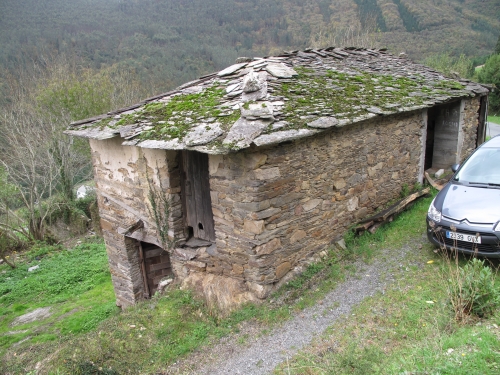
Little house as it stands

An added complexity is the roof of the main house, which showed some signs of further deterioration when we visited at the start of January. The recommendation, admittedly from builders with a vested interest, is that we look at getting it replaced sooner rather than later. This, however, is an ‘Obras Mayores’ (major works) and will require full permission.

It looks like our architect may be rather busy over the coming weeks!

Posted in Background, The House in Liñeiras | 2 Comments

But what about the bulldozers?

I’d like to categorically state that I don’t read the Daily Mail. Never have, and never will. It’s print has never blackened my fingers, I’m a Guardian man. However, Amanda does occasionally glance at the online version which I guess is solely to get a heads-up of what the reactionary ultra-right are currently complaining about.

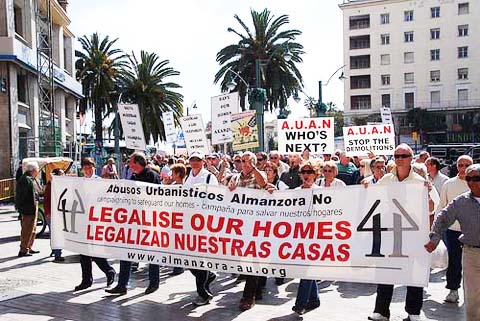
Articles like the one in this mornings online version about a hapless, law-breaking, ‘got just what they deserved to the indignant outcry of the anti-Spanish Daily Wail’, do make for interesting and somewhat alarming reading. Mr & Mrs Hartshorn, owners of a soon-to-be pile of rubble near Marbella have been given a massive fine, sentenced to eight months each in prison, and are facing the destructive force of the Spanish bulldozers.

When we’ve mentioned our Galician property to people, many have raised eyebrows and mentioned the demolition craze currently sweeping the southern Costas. We try and put their minds at rest, while maintaining a healthy concern ourselves, that things in Galicia are very different and that we are following the rules to make sure that we don’t find ourselves facing a hefty fine or the prospect of ‘porridge’.

Back to the hapless Mr & Mrs Hartshorn. There is no excuse for what they have done, they have plainly and simply broken the law and ridden roughshod over the Spanish planning process, probably encouraged by unscrupulous developers and their equally blasé ex-pat neighbours. They bought a piece of land with a very small building on it and when their planning application to build a massive sprawling villa was turned down, they went ahead and built it anyway. Following this course of events in England, or for that matter any first or second world country in the world, would prompt a similar course of action from the authorities.

The Hartshorns case seems clear cut but there are many others who find themselves in such a situation who do deserve more sympathy. These are people who developed properties with the correct paperwork in place but who were later told that their permissions should not have been granted. While brown envelopes full of cash may well have oiled the wheels of bureaucracy, those ex-pats caught up in the development trap were simply playing the game that was necessary at the time to realise their dreams. In these cases it is the corrupt and corrupting officials who should pay the cost not the victims who should lose their houses.

Many unfortunate home owning ex-pats

Are we immune in our little Galician haven? Probably not.

We are aware that our house is on agricultural land and we have to get permission for the renovations from the relevant government department. We are planning a tourism use and have to get tourism approval before starting too. We also know that current planning law only allows us to extend the existing building footprints by a maximum of 10% and we’re making sure that we stick within these limits. And we’ve employed an architect who knows the local planning law inside out and she is making sure our plans conform.

Despite this we are still being encouraged by many people to ‘get on with it’ before we get the relevant approvals/licenses/permission as no-one will complain or mind. It would be so easy to take this often well-meant but ill-placed advice and bring our plans forward. But, call it dragging our feet, call it being cautious, we are making sure that we don’t fall foul of the authorities.

Posted in Current Affairs, Local Life | Tagged | Leave a comment

Making plans for the small house

You’ll hopefully remember both ‘the small house’ (the edifice that we used to call the barn) and the top secret architect  (the woman with no name)? These two have come together in exquisite harmony to produce a plan for stage one of our development of Liñeiras 13.

We’ve planned five phases of development for the seven buildings that form our property;

  • Phase I – The small house into an apartment for us and a site-office.
  • Phase II – The main house into the Casa Rural
  • Phase III – The ‘horno’ (bread oven house) into a hotel reception and working bread oven.
  • Phase IV – The renovation of the ruined house (2) to the east of the main house into something as yet unplanned.
  • Phase V – The renovation/reconstruction of the ruined houses (2) to the south of the small house into something else that we’ve not yet planned.

For the present we’re concentrating on Phase I, and after last weeks trip to the house showed that the winter had not been kind to the main house, possibly the replacement of its roof as part of Phase II (subject to licenses). We’ll then keep going until we run out of money, which may be sooner rather than later!

Despite suffering from a heavy cold and fever (what women call Man Flu) our architect has drawn-up her ideas for the small house. She talked us through them last thursday and we both loved them. This will be our house, the place where we’ll spend our non-working hours, and which we will use as a site office for the renovation of the main house.

First up, the small house

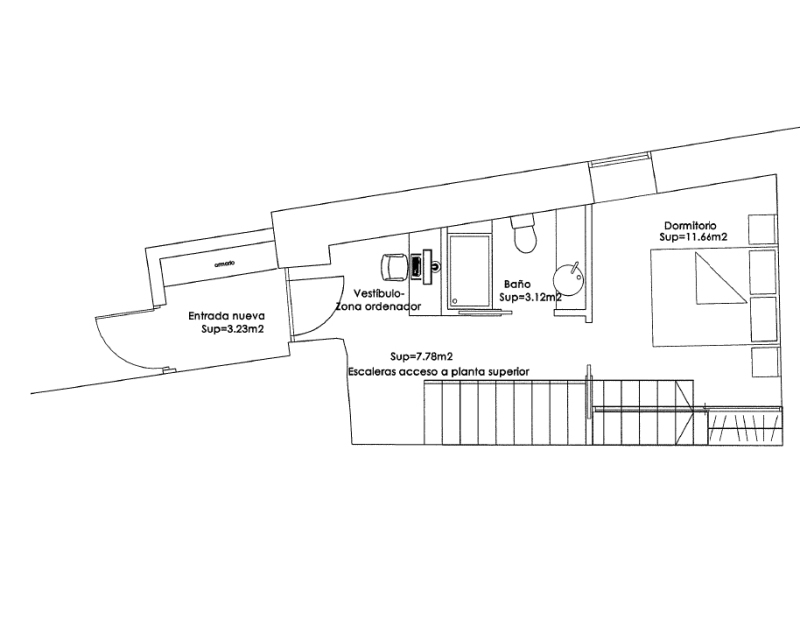
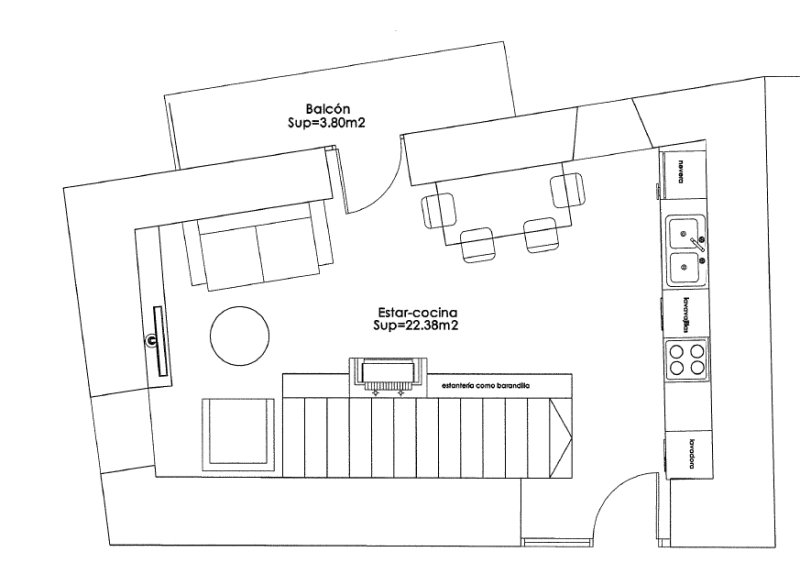
The architect has suggested an upside down house. The bedroom and bathroom with be downstairs where the animals used to live (no comments please!) with the upstairs being the kitchen and living room. We’ll be adding a small entrance hallway and a narrow balcony on the south facing wall to allow us to make the most of the sunshine and the views. Despite its small size (only thirty-five square metres per floor) we think that the architect has done a great job in utilising the space with sliding doors, and cramming in as much storage as she can.

Downstairs

There will just be one small window downstairs allowing light into the bedroom, and the bathroom will be pretty small, but the entrance hallway will keep the winter weather out and there will be a small study area for the all important computer. The staircase (of as yet undetermined material) will lead to the first floor open plan living space.

Upstairs

Upstairs there will be a small kitchen, dining area and a sitting room with a door on the north of the building leading to the road side and another out onto the one metre wide balcony from where we can benefit from all day long sunshine. A pellet burning heater will provide winter warmth and there will be an area to relax and watch TV.

We suggested a couple of small changes to these plans and the architect is now completing the final drafts to enable her to submit the project so that it can start its epic bureaucratic voyage through the many levels of Galician government.

The plans make the best of what is already there with just the construction of the entrance hallway and the increasing in size of one window. That should keep the costs down and ease the path through planning. There are several other things that we can be getting on with while we await the governments verdicts, and more of these over the coming weeks.

Posted in The House in Liñeiras | Tagged , , , | 1 Comment