A surprise encounter

I guess that we have our fair share of processions in England although they are moving away from the traditional religious and ceremonial more towards the confrontational and sinister. The far right, student tuition fees or anti-G10 summit is now the context with increasingly aggressive protesters flanked by police, while helicopters video proceedings from above.

What a refreshing change then when a quiet Saturday morning stroll around Oviedo was interrupted by a procession of a very different type. Around the corner came an Asturian gaita marching band in full regalia, and not a Guardia Civil anywhere to be seen.

Before watching you may wish to turn the volume down a little as this one packs a punch!

[mediaplayer src=’/sadfish/visitgalicia//Band.wmv’ muted=0 ]

Posted in Local Life, Video | Tagged , , | Leave a comment

An Asturian jewel

Oviedo is the capital city of Asturias, founded in the eighth century, and the birthplace of formula one racing driver Fernando Alonso and Carmen Polo, the wife of Spanish dictator General Franco. It is located some 50km south of the airport which often bears its name (actually Aeropuerto de Asturias) and which gets daily summer flights from London Stansted, 195km from the ferry port at Santander, and 177 km from our house in Liñeiras. We visited on our last trip spending a night at the Silken Monumental Naranco and were enchanted by everything that this city has to offer, except perhaps its vinegar cider.

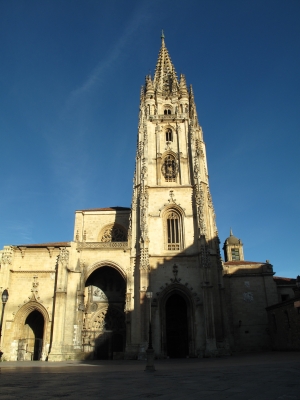
Oviedo Cathedral

The Catedral Metropolitana Basílica de San Salvador is located at the heart of the old town and an important stopping off point along the pilgrim route to Santiago de Compostela. The cathedral is a real mish-mash of architectural styles and it backs on to the monastery of St. Vincent (home to the archaeological museum of Asturias) to form a large and impressive complex.

During the Spanish Civil War the city was the location of a famous seige when Colonel Antonio Aranda Mata held out for the Nationalists against the rebellion for just under three months before being relieved by Francos army.

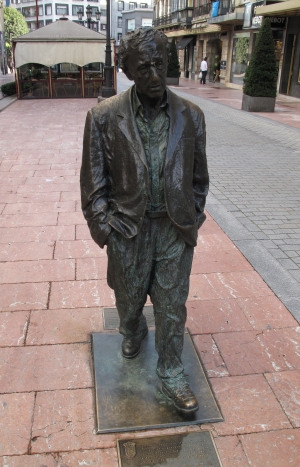
The old and new parts of the city have many sculptures by varied artists including a life sized bronze sculpture of Woody Allen , one of the finest comedy actors and directors of all time, who once said  ‘Oviedo is delicious, exotic, beautiful, clean, pleasant, peaceful, and kind to pedestrians. It’s as if it doesn’t belong to this world, as if it could not possibly exist … Oviedo is like a fairy tale.’ Oviedo featured in the recent Allen directed movie  ‘Vicky Cristina Barcelona’.

Woody loves Oviedo

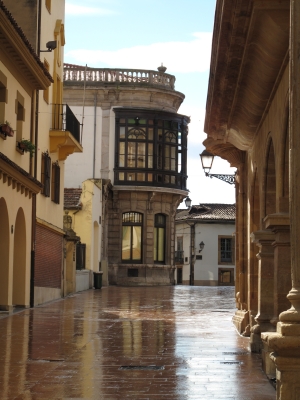
The city itself has all the bars, shops, hotels, sculptures and cultural attractions to fill several days soaking in the atmosphere, admiring the sculptures and walking through the parks and meticulously kept streets.

Fresh from a good street cleanse

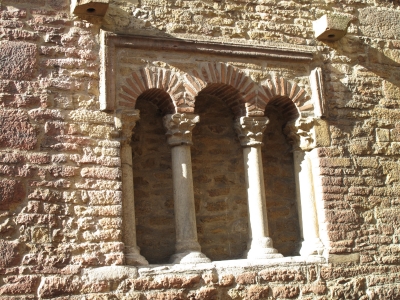
Superb architecture

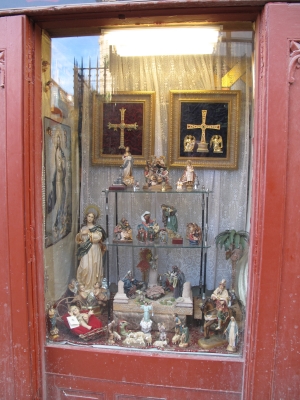
Of course it does have its curiosities, as does every Spanish city, and around every corner is something to remind you of which quirky country you are in.

Religious icon anyone?

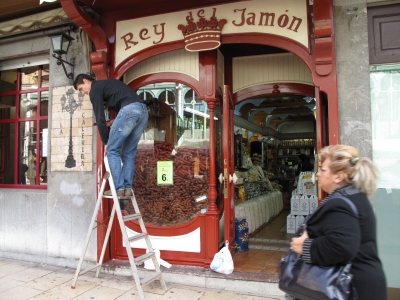
Finally a photograph that it was impossible to resist taking (if only to ‘cock a snoop’ at our English pandering to environmental health). If the punchline wasn’t so obvious I’d use it for a caption competition.

The 'King Ham'

Posted in Local Life, Places to Visit | Tagged , , , , | 1 Comment

Cider house rules

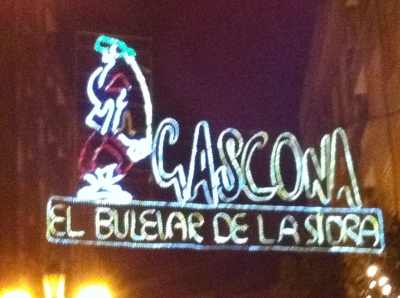
The most famous street in Oviedo is called Gascona. Not a particularly long, elegant, or architecturally pleasing, its claim to fame is that it is the Asturian capital cities centre of cider drinking.

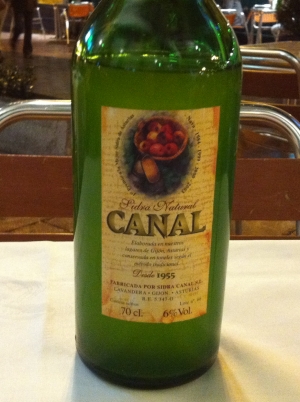
A shallow sloping, marble surfaced, pedestrian way lined with small tapas bars serving the Asturian regional drink ‘Sidra’ from green 70cl bottles to locals and tourists alike. It is a ‘don’t miss’ on anyones travels around Galicia and Asturias.

Most famous street in Oviedo

Going out for a cider in Asturias is like going to the theatre elsewhere in the world. It is not so much having a drink, as watching skilled craftsmen, and rank amateurs at work. Let me explain.

On arrival at a bar, and you apparently should visit many over the evening, you take your seat and nod to your waiter who will bring over a bottle of the 6% proof fermented apple drink and place it on your table. You admire it, without touching, for a minute or two and then he arrives with a tumbler and asks if you would like a drink from your bottle. You nod and the performance begins.

One of many varieties

The waiter picks up your tumbler and stares straight into your eyes, not averting his gaze for the duration of what is about to follow. He then positions your tumbler in his groin, full extending his left arm downwards. Then he takes the bottle in his right hand and extends his arm above his head before pouring a little from the bottle to get his bearings, trickling the sweet apple alcohol until he finds the rim of the glass. Once he is oriented, he increases the flow until there is a couple of inches of cloudy, and now aerated, cider in the bottom of your glass which he then hands to you while slamming the bottle back on the table in a crescendo of self praise. You drink the fruits of his acrobatic liquid dispensing in one gulp before tipping the dregs onto an already sticky sweet marble floor and returning your glass to the table. A few minutes later the whole process begins again, and so on until the bottle is empty and you order another or move on to the next bar.

[mediaplayer src=’/sadfish/visitgalicia//pa4.wmv’ ]

Despite the sidra being served up being a decent 6% proof this is not the easiest way to get yourself rapidly intoxicated. For all but the most experienced of waiters the majority of your beverage ends up on the floor, their shoes, or down the front of their trousers. At the end of the night the street is awash with sticky cider and I can imagine that in the summer months drinkers must be plagued by the wasps that so favour the Asturian apples in their natural state.

Added to the smell and sticky state of your lower garments is the sad revelation that the cider is absolutely awful. Forget your Bulmer, Kopperberg, Magners and Strongbow, this is nothing like you’ve ever tasted.

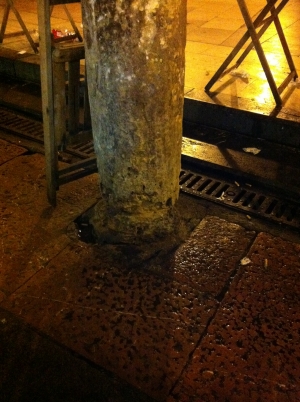
Just to be 100% sure that it was all as bad everywhere we moved to another bar where I sampled a brew from a different cider house. It was just as bad…and look what it had done to the base of the pillar next to our table.

Stone pillar eaten by cider

You have been warned…but it is worth the experience.

Posted in Food & Drink, Local Life, Places to Visit, Video | Tagged , , | 1 Comment

A Spanish Christmas

We’re optimistic, possibly overly-optimistic, that this time next year we’ll be snuggling up in front of our newly installed log-burner for a Christmas holiday in ‘the small house’, as the snow falls outside and we await the arrival of Father Christmas bearing our winning ‘El Gordo’ lottery ticket.

Brought crashing back to earth with the current advice on getting planning permission it looks more likely that 2012 will see our first Galician Christmas, but whenever we do manage to hold our festivities Spanish-style, what should we expect?

One certainty is that the Spanish know how to celebrate Christmas. They string the whole thing out over a month starting on the 8th December and running until the 6th January, and there is plenty going on throughout the period.

8th December – Feast of the Immaculate Conception

This is a national public holiday which kicks off the festive period as Inmaculada is celebrated. Not Inma our Gestoria, but the conception by the Virgin Mary. Why this is just seventeen days before the birth of Jesus is a bit of an enigma, and I would prefer to remain ignorant, but perhaps she managed to hide her pregnancy well for the first eight and a half months?

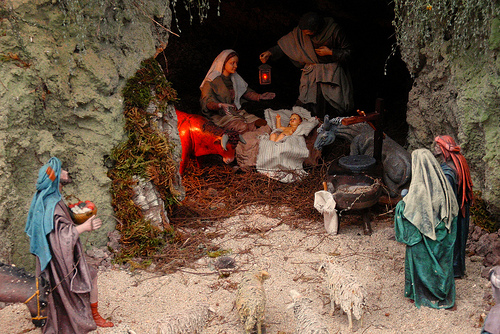
This is also around the time when local governments, civic societies and individuals use any possible vacant public space to erect a ‘Belen’ (Bethlehem in Spanish), a nativity which is extended to over the coming month with the major players being added as they came on the scene.
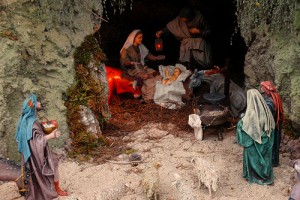
Belen de España

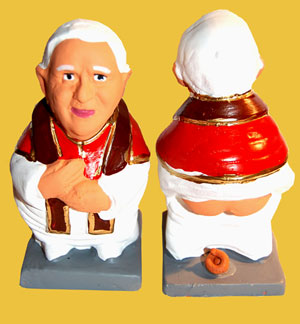
One uniquely Spanish sub-plot to the whole nativity scene is the addition of a Caganer, a character squatting to defecate, which is added to all Belen for the children to find, and which symbolises fertility. Novelty caganer abound and you can get one fashioned to represent almost any public figure you wish.
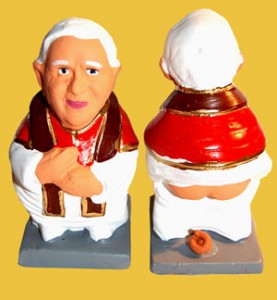
Pope having a poo

21st December – Hogueras

In some parts of Spain, notably Granada, there is a celebration of the shortest day symbolised by jumping through fires to protect oneself from illness in the coming year. All sounds a bit pagan in a Catholic country to me.

22nd December – El Gordo

The day when all Spaniards cross their fingers that they will be the ones to win a share in the largest lottery of the year. This was traditionally massive, with sums of money being won way beyond what used to be possible elsewhere. This has now been somewhat eclipsed in financial terms by EuroMillions but it is still a big Spanish institution with bars, restaurants and offices all usually buying an expensive group ticket to be shared amongst colleagues and patrons.

24th December – Nochebuena

A night for a family get together as restaurants and bars all close early (as we discovered to our cost, and hunger, when we lived in Madrid in 1992). Traditionally a night for drinking Cava and fine Rioja while eating prawns, lamb and turrón, although not all on the same plate.

25th December – Christmas Day

This is where it all starts to get a bit weird if you are used to a traditional English Christmas. Santa may arrive with a small token present for the children but this is another day for families and not for the northern European tradition of exchanging gifts. I suspect that this is mostly down to the Spaniards wanting to bribe their children into behaving for the whole school holidays and not just until the 25th December.
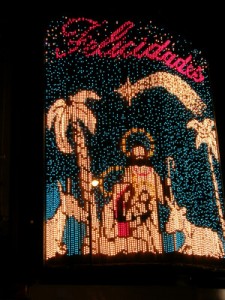
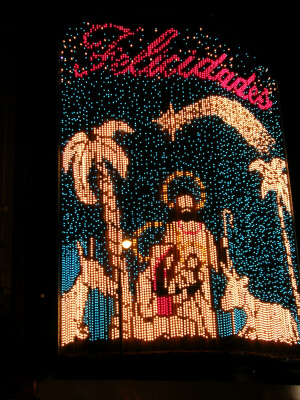
Felicidades courtesy of El Corte Ingles

28th December – Santos Inocentes

There is no ‘boxing day’ in Spain, instead the next party is on the Holy Innocents Day, the Spanish equivalent of our April fools day. Practical jokes, youths taking on the roles of local council officials and ordering around their parents, and big bonfires all figure prominently. This is also the day not to believe everything that you read in the newspapers or see on the TV news.

31st December – NocheVieja

Although you may think that every night is party night for the Spanish the last one of the year is really special. Clubs, bars and restaurants all get extortionate in the way that they do in England but as the midnight hour approaches all city, town and village squares fill with people armed with 12 grapes (one on each chime of midnight) and bottles of bubbly to wash the grapes down with. The party is then unlikely to stop until dawn and the following day is spent sleeping off the previous nights excesses.

5th January – Eve of the Kings

Spanish town and village streets fill with processions as sweets are thrown from floats to notch up the excitement of the day to follow just a little further. Each town has its own variation to signify the arrival of the three kings in Bethlehem, bearing those all important gifts.
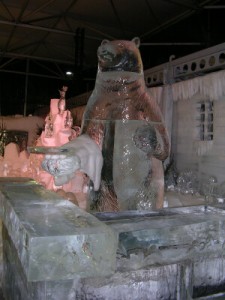
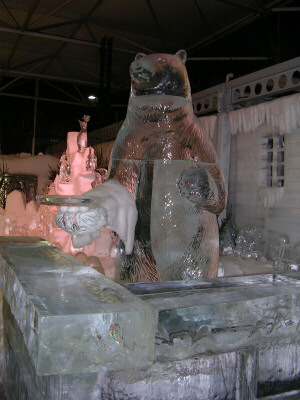
Drink Sir?

6th January – Los Reyes

The day before the kids go back to school and it is time for the dishing out of the presents which have been left by the kings. Balthasar is the favourite, riding a donkey, as it is he who is believed to leave the gifts, making Santa seem a little second rate for Spanish youngsters. Once the presents are opened there is just one more sleep and it is back to school and work, and the festivities are all over for another year.
Posted in Food & Drink, Local Life | Tagged | 2 Comments

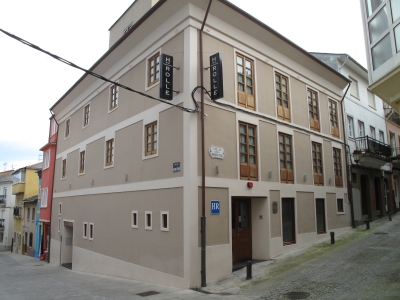
Hotel Rolle, leading by example

It would be easy, if somewhat boring, for me to blog about the hotels we’ve stayed in. But on this occasion I am going to tell you about Hotel Rolle in Ribadeo, and for good reason. 

Hotel Rolle

Jose Carlos Rolle Vijande is a brilliant host, keen to please, eager to chat, and highly knowledgeable about the Ribadeo area and Galicia/Asturias. The smart beige and cream decorated hotel is tucked away on a back street, off the main square and just up the steep road from the harbour. It is conveniently situated on the edge of town and on week-nights it is warm and quiet with welcoming rooms and free wi-fi Internet access (a boon to the travelling digital addict). The breakfasts are top-notch with a nice big cup of strong coffee and home made cake.

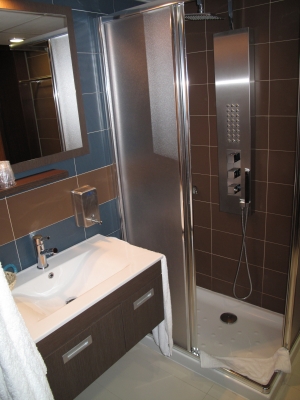
But the main reason I mention it is the wonderful job that Jose Carlos and his builders have done in renovating a shell into such a delightful hotel, with many features similar to those that we’d like to have in our Casa Rural. Starting with the bathrooms, bright, modern, well lit and with top-of-the-line installations such as this amazing multi-function walk-in shower.

Ultra-modern bathrooms

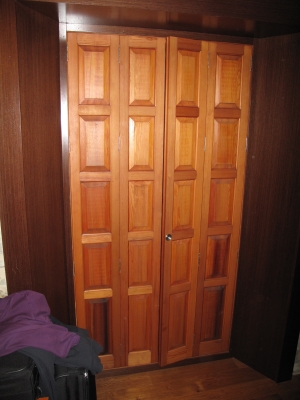
The rooms have exposed hand-pointed stonework and the windows are double glazed with these brilliant hand-made shutters which fit snugly into place and keep out any daylight and street noise.

Hand-made shutters

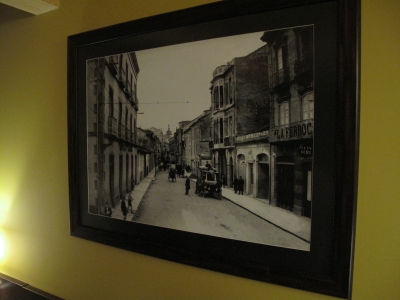
Finally, each room has a theme and a unique name which owes something to the framed photographs taken by the owner and some point in his long and illustrious past.

Old Galicia

This really is a nice place to stay, not overly expensive and certainly far cheaper than the Ribadeo Parador which, to be honest is a bit of a disappointment. The only word of caution with Hotel Rolle is to avoid Friday and Saturday nights as the hotel is reputed to be next to (we’ve never been there to validate the claim) one of the noisiest all-night clubs in Ribadeo. But on any other night the loudest sound you’ll hear is a car traversing the cobbles, or Amanda and I returning to our room after one too many glasses of Albariño.

Posted in Local Life, Places to Visit | Tagged | 1 Comment