The ancient home of the celts

Apart from the business that we needed to conduct on our last trip, we also decided to take an extra day and hit some of the local tourist trail. On the Friday morning we set off for Oviedo where we would later indulge in the tapas I mentioned in the last blog entry, and try our hand at the famous Asturian cider. On the way we made a slight detour to Castro de Coaña, a ruined 4th century B.C. Celtic hill fort settlement.

The site, near the village of Coaña is just a few miles south of the A-8 which runs along the north coast, and about twenty minutes drive east of Ribadeo, and it is well worth an hour of anyone’s time to visit.
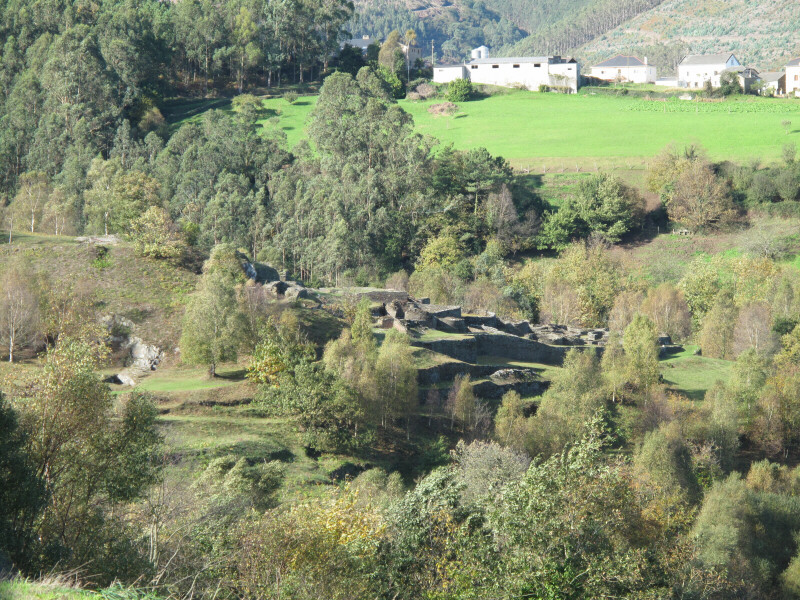
A glimpse on the approach

When we arrived at the large, grass roofed, visitor centre around 11am the place was totally deserted apart from two ladies, one manning the ticket kiosk, and the other the small souvenir shop. Entry was about 3€ each which allowed you take as long as you wanted to meander amongst the ruins before getting back in out of the autumn wind to peruse the small museum of artifacts discovered during archaeological digs on the site over the last century or so.
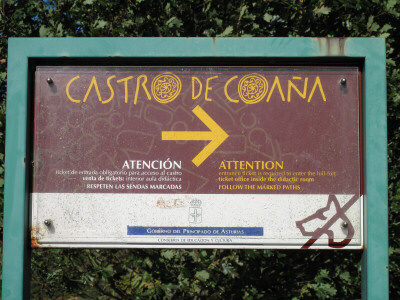
In you go

A short path through a field lined down the edges with upright stones (a twenty-first century addition) and through a security gate (unmanned) and you are into the complex which was once home to several hundred Celts living in the 80+ stone huts that have so far been discovered. Some of the site still remains unexcavated.
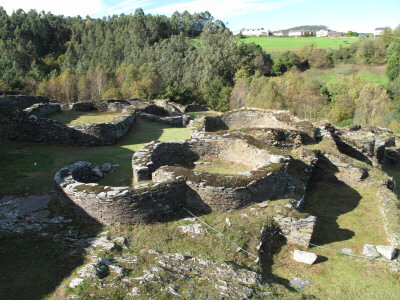
Over eighty round stone huts

The site is built on a steep escarpment and protected by natural cliffs on one side and a moat and wall arrangement on the other. The houses are on three standard floor plans and most of them are detached with only a small number sharing ‘party’ walls. They range from the smallest at little more than two metres diameter to some much larger at seven plus metres across.
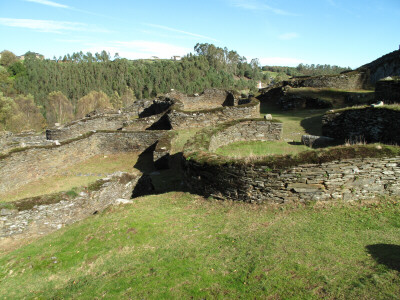
Small and large

The site also has some communal facilities such as drainage, a town square, an acropolis (citadel) and even what are believed to have been saunas (with fire places, a bath, a boiler and drainage channels).
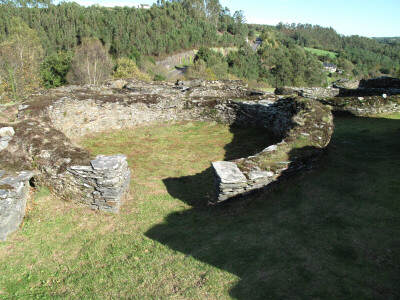
Would have been thatched with a central fireplace

Most of the buildings were thought to be about two metres high but there is some archaeological evidence that some may have been two stories probably with sleeping on a mezzanine floor to take advantage of the warmth from the animals below. Littered on the floor of some of the houses are large granite blocks into which have been carved holes. These are thought to be mortars, originally placed near to the fireplace.
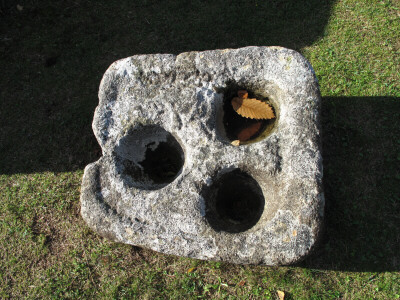
Food preparation mortars

Other artifacts found on the site suggest that it was in use for five or six centuries, and from the finds it seems that there was a degree of Romanisation, before it was abandoned and covered over until being discovered in the late 19th century.

It is a magical site, especially when you have it entirely to yourselves on a chilly autumn morning. Your mind doesn’t have to try too hard to imagine it as a bustling village, echoing to the sounds of children and animals and full of the smell of food cooking on over eighty open fires. Well worth an hours diversion on the way to, or from, Asturias airport, just not on mondays as it is closed.
Posted in Local Life, Places to Visit | Tagged , | Leave a comment

Food, glorious food

I have a problem with taking photographs of food. It’s nothing moral, nothing even technical, it is more a case of despite my best intentions to catalogue our foray into Galician cooking I am usually half way through the dish before I remember that I was supposed to photograph it.

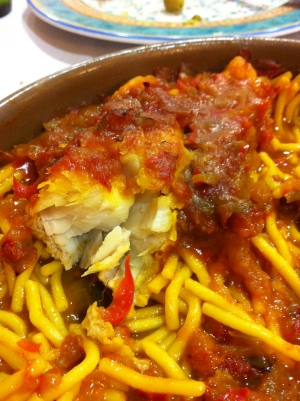
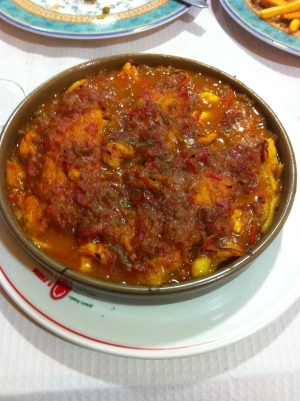
The exception to prove the rule is a fantastic dish we discovered in a little hotel restaurant in Ribadeo on an earlier trip, and once which keeps tempting us back to further guess the ingredients that go to make Merluza y Gambas con Fideua. Here are the before, and half way through pictures, of a fabulous hake and prawn with pasta dish cooked with a strong fish stock and usually served with the fantastic ubiquitous crusty Galician bread.

Before the first fork full

Now I admit that sat there in its little terracotta pot it doesn’t look too appetising but if I had a smellovision blog you’d be salivating in anticipation. That bowl is around 10″ in diameter and full to the brim. I only made the mistake of having a starter before this dish once.

After twenty minutes joyous work

And all this for under 10€. Bargain.

Spanish breakfasts tend to be a lighter affair that the traditional Full English. Comprising bread, toast, cake, jam, best butter, juice and great coffee, this is what the wonderful Hotel Rolle  served us on our stay in early November.

Now that's what I call a coffee

Most people associate Spanish cuisine with either tapas, or paella, and both have regional specialities. We’ve not seen a great deal of paella in the north west although I dare say that if we sought it out then we would find excellent local renditions. Tapas, on the other hand, has been oft sampled on our travels and below are some of our favourites.

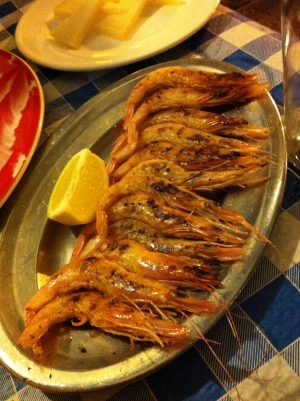
Everyone loves gambas

Large prawns, lightly grilled and simply served on a stainless steel platter sprinkled with rock salt, pepper and a slice of lemon. Finger licking good!

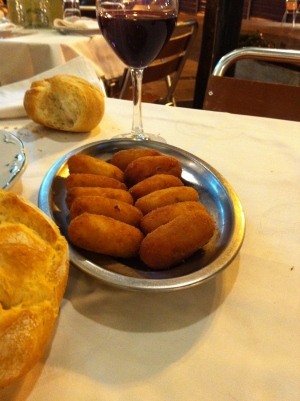
Croquetas, these were with ham

Croquetas come in many varieties and shapes and sizes. Our favourite is the seafood variety, although these are with ham (con jamon) and were sampled on the terrace of a sidreria (cider bar – more on this in a later blog) in Oviedo.

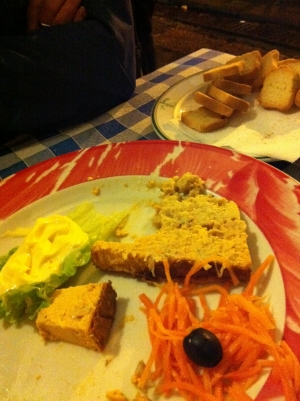
Pate de Centolla

Once again half-eaten, this is Pate de Centolla which is usually made in house from the king crab, not the most beautiful of Gods creatures, but it makes a sensational pate. 

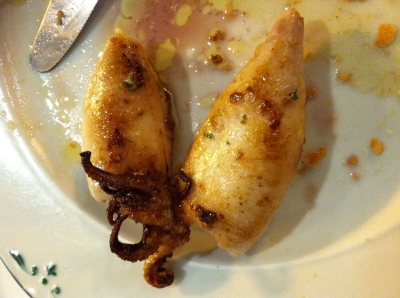
Fried baby squid

Chipirones are a dish of fried whole baby squid that you can find across Spain but they are particularly good in Galicia and Asturias. These were the last two of a big plate full and were cooked in olive oil with a generous helping of rock salt and garlic. Absolutely divine.

You’d be forgiven for thinking that we do very little other than eat when we visit Galicia, but as they paraphrase ‘when in Galicia…’. 

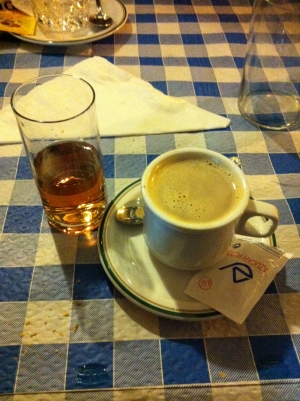
Finally, what better way to finish off a meal than a nice coffee and my personal favourite tipple Havana Club Rum (Ron in Spanish), this half-glass was just 3€.

The perfect meal conclusion

Posted in Food & Drink | Tagged , , , , | Leave a comment

TOP SECRET – Our new architect

The main reason for our trip earlier this month, apart from stocking up on traditional Christmas turron, and feeding our faces with the best food and drink in the discovered world, was to meet with our potential new architect (the fifth we’d met so far on our quest).

For reasons which may be explained in the future I am not allowed to tell you her name, suffice it to say that she is a graduate of the University of A Coruna, a member of COAG (Colexio Oficial de Arqitectos de Galicia), and that she lives about 60km, cross-country from our house. She is bang up-to-date with all the latest legislation (and there are many reams of it) , and she mirrors our taste for traditional Galician restoration. Oh…and she shares her christian name with my Aunt (although for most that will not be the best of clues). With the exception of the the name similarity thing, she ticks all the right boxes.

We’d arranged to meet her in Pontenova and immediately felt relaxed with her. The conversations were all in Spanish, Amanda conversing fluently, myself chipping in with the odd word to at least try and look willing.  We offered her a lift to the house and after Amanda trapped her finger in the seat adjuster (covering the pain so well even I didn’t know until after we were alone again) we took the seven minute trip ‘home’.

In the November sunshine

Our architect, lets call her ‘X’ as it is Galicia’s favourite letter, knew where the house was but hadn’t had a proper look around. As we showed her the house she made encouraging conversation.

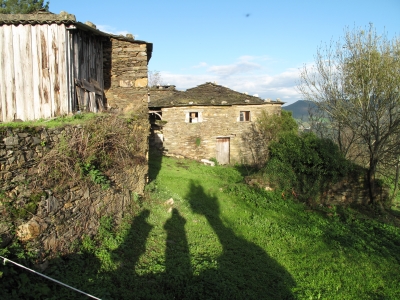
Small house left, main house straight

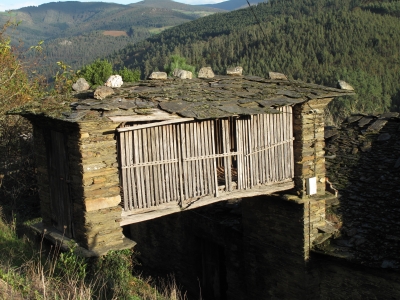
She agreed that the small house was indeed a small house, much to our relief, after I pointed out the house-like features (window seat, chimney, balcony, separate entrances). She loved our hórreo, and inside the house agreed that there was much potential including the capability for it to comfortably host six en-suite double bedrooms. She was almost as excited as we were, and we liked that!

Hórreo needs repair

‘X’ came through with several immediate suggestions.

  • Firstly we should submit an application to turn the small house into a dwelling for ourselves (perhaps as a result of our initial suggestion of the same).
  • In the meantime we should apply for minor works licenses (obras menores) to enable us to repair the roofs of the small house and the main house. ‘Repair’ is being used here in a way as to be open to several interpretations.
  • Once we have permission for the small house then we should immediately put in for permission for the large house and the repairs to the hórreo (which requires separate permission from Patrimonio). 
  • Once the big application is under way apply for minor works licenses to ‘repair’ (there is that word again) the windows and doors.

The bad news is that she thinks tha the full permission for the little house could take up to twelve months to obtain, and the license to allow us to convert the main house into a Casa Rural could get tied up in red tape for up to three years. This is due to the numerous committees that have to be consulted and then pass the application.

Mental time-scales re-adjusted, an architects quotation to assist us, and armed with photographs of her previous projects, we appointed ‘X’ as our new architect. She’s off to the small house this week to measure up and we hope to have some outline plans by Christmas before we travel out there again in January to sign the applications for the conversion and the minor works.

Now we feel like the project is getting underway….and just five months after the house became ours.

Posted in Local Life, The House in Liñeiras | Tagged , , , , | 2 Comments

When is a barn not a barn?

The answer is…of course…when it is a small house!


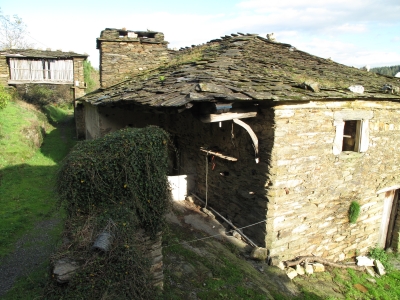
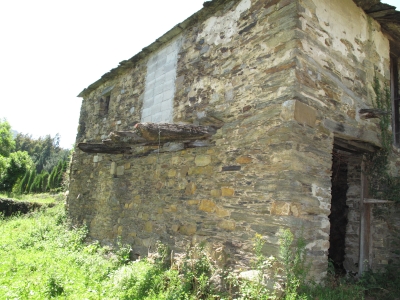
Our small house, view from the big house

Let me explain.

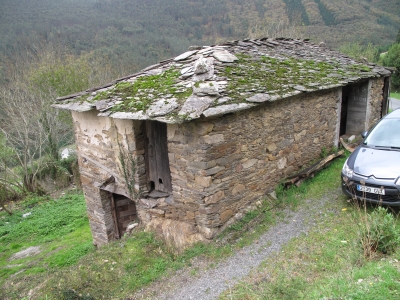
From earlier articles you’ll be aware that our ‘house’ actually comprises several buildings, one which we have consistently referred to as ‘The Barn’. On the basis that this small building (internal measurement is only 35 square metres) is full of hay and the residence of Carlos’ donkey we felt fairly confident that it was a barn, a ‘pajar’ in Spanish, and that’s how we’ve been referring to it in discussions with architects and builders. That was until we met the ‘secretario’ at the Pontenova Concello, the second in charge and the man with our future in his hands. In a brief conversation he advised us that the Galician Xunta (pronounced chunta) no longer permitted the conversion of barns into residences. On receiving this news back in September it threw all our plans into turmoil.

Seen from the road

Our idea had been to convert the barn into a residence for ourselves which we would then use for staying in during site visits and as the site office for the renovation of the big house into a hotel. We needed a separate building as our residence to meet the ‘Casa Rural’ requirements and our plans lay in tatters.

The next hour was one of mental angst while contemplating putting the house at Liñeiras back on the market and starting our search all over again. There was silence in the car as we drove back towards the airport, Amanda and I in grief at what was looking like the loss of our dream, and Mother sat in the back keeping her own counsel as she sensed our increasingly desperate mood. Then I had a flash of inspiration, a revelation, I’d seen the light like Saul on the Road to Damascus, only we were heading for Aviles, I hadn’t heard Gods voice, and I was already called Paul!

The window seat, obviously a house!

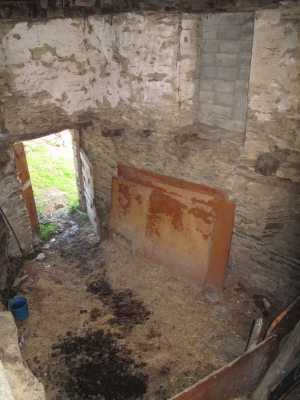
The barn wasn’t a barn at all, it was a small house. Traditionally the Spanish kept their livestock on the ground floor and lived above so that they benefited from the animals heat (and smell) in the cold winter months.

Our ‘barn’ had previously had a second floor, with rendered and whitewashed walls, a window seat, balcony and separate entrances. There was no Xunta ban on renovating a house, I shared my revelation and the mood in the car was immediately lifted.

The old stable area

From now onwards the barn would never again be called a barn, now it was our small house.

[mediaplayer src=’/sadfish/visitgalicia//Barn.wmv’ ]

Posted in Background, The House in Liñeiras, Video | Tagged , , , | 2 Comments

Don’t just take my word for it….

….here is what international film star Martin Sheen (Ramón Antonio Gerardo Estévez) has to say about Galicia!

Martin Sheen on Galicia

Publicising his new film ‘The Way’  which is about his characters pilgrimage to Santiago de Compostela. You have to take some notice of what he says. He was after all in Apocalypse Now, one of the best films ever made!

Posted in Current Affairs, Local Life, Video | Tagged , , | Leave a comment