A ‘bewilderment’ of architects

On the internet I’ve found a number of suggestions for the collective noun for architects. These include; ‘charge’, ‘confusion’, ‘glass house’, ‘jealousy’, ‘bewilderment’ and ‘arrogance’. There seems to be no consensus.

We’d been collecting architects as we’d gone along, a bit like you might collect beer mats or stamps but less tangible.

This was our fifth time in Galicia since starting our quest. We’d got the key to our future home and business, and an ever lengthening list of potential architects. All were keen and willing to help us, although I suspect that all could see big ‘€’ signs, and were desperately hoping that the English that they’d just been introduced to had bottomless pockets.

One thing which is for certain is that architects are nice people. Every one that we’d met were friendly, open, warm, human and all but one spoke English. But the thing is…they aren’t ‘wired’ up in the same way as you and I. When you say the words ‘inexpensive basic renovation’ their in-built architect translator makes them hear ‘design something revolutionary, inspirational, award winning full of new technologies and techniques…and to hell with the budget’. Their sociable external demeanour seems to hide a psychotic core.

So far on our travels we’d met; José from near Tui, Gonzalo from Santiago, Antonio from Lugo, Juan from Ribadeo and then the day after we bought the house Ramon introduced us to Fernando from A Coruña. After seeing the beautiful architectural site survey that Fernando had undertaken for one of Ramon’s houses (our estate agent and new neighbour) we were smitten. We bundled him, and his assistant Luz, into the car and forced them to come and see our house. We had to have a survey, to know what we’d bought, what all of the rooms measured, and to see if anyone could actually penetrate the forest that was growing in the ruined houses.
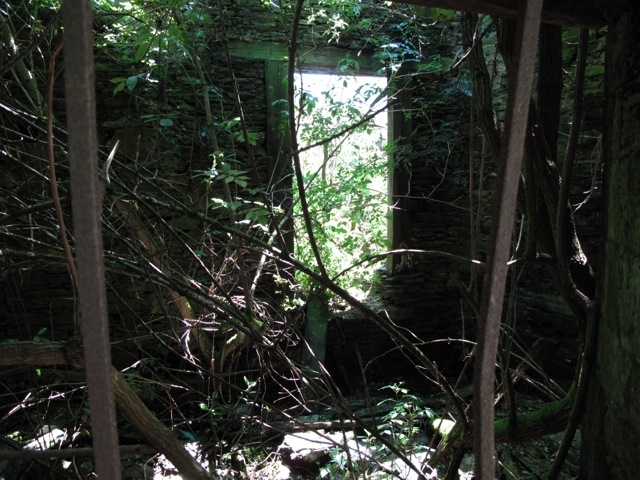
The house forest

Fernando made all the right noises, re-assuring us that we’d made a good purchase, commenting on how grand the house was, and that the size of the horno(bread oven), at Liñeiras 13 it is a separate house from the main house, meant that this truly was a high status property back in the day. He made us feel smug, and we liked that.

He encouraged us to find out what the local name was for the house that we could use for the business, identified some masonry which he believed would have been the base to an impressive dovecote and he even made friends with Carlos’ moth eaten donkey, who’d now taken to stamping his hooves aggressively whenever he saw me.

We asked him for a price to undertake a full architectural survey and give us a set of plans similar to those that we’d seen him deliver to Ramon, and if the price for this was right then we’d suggested that we’d like him to come up with some outline ideas for the small house, the one which Carlos’ donkey was currently guarding.

The rest of our final day went quickly, and early the next morning we were on our way to the airport for our trip back to reality. No more visits were planned, all our hopes were with Fernando to get on with the work, and then to need us to visit again to see the plans.
Posted in Background, The House in Liñeiras | Tagged , , , , | 1 Comment

I love pontenova.es

Not long after we decided to buy the house in Liñeiras a local news/blog/magazine/public information service came to our attention. Amanda stumbled across www.pontenova.es and ever since we’ve both been hooked.

www.pontenova.es

I’ve been reading (in the broadest sense of the word, as the site is written predominantly in Gallego) it a couple of times a day for the last couple of months and trying to work out what the wording that goes with the pictures actually means. Sometimes the picture, and the odd word that I understand, is enough for me to get the gist of what is going on, but sometimes I am disastrously wide of the mark in my understanding.

Pontenova.es seems to have three main subject areas which are covered in massive detail.

  • Top of the list is Sporting Pontenova, the local football team, who are in 2nd Autonomic, G. VI, which is quite a long way below the likes of Real Madrid and Barcelona. I am guessing that because of the exhaustive coverage, the author of the site is either involved in the club or a massive supporter.
  • Second is the river Eo which runs through the centre of Pontenova comes a close second, although I suspect that the trials and tribulations of the attempts to build a river beach, in-between the flood waters which frequently wash away several weeks worth of work, has been the main focus of the debate.
  • And thirdly, the site has a leaning towards the publication of old photographs of Pontenova (smothered in a massive watermark) that show ‘olden day’ life as it was in the nearest town to our new house. These are mostly photographs of quirky little mine trucks, Sunday best suited religious processions and summertime group gatherings and away days. They are quite delightful giving an insight into the history of the area, and show a naivety which is now sadly leaving Spanish society, in the same way that it left our British shores a long time ago.

It is one of these photographs (please click here) which has caused me to finally bring one of my guilty private pleasures to a wider audience. I saw this photo and instantly smiled.

Perhaps we should use it for a caption competition?

Posted in Local Life | Tagged , | 1 Comment

The longest day

The sun was up very early on the morning of the longest day, but not before us. A restless night had followed an evening in the Pulperia with Ramon, and a new client of his Rachel. While Ramon, Amanda and I had feasted on excellent pulpo, calamares and chipirones as well as a great big slice of tuna empanada, poor Rachel (a vegan) had made do with boiled potatoes sprinkled with paprika. Galicia isn’t really the ideal spot for vegetarians, let alone vegans.

A quick coffee, too nervous to eat, and we met with Inma who would hold our hands for the next couple of hours, first stop was to go and see Jesús at the bank to collect the large cheque. A short walk across town and we were arriving at the offices of the notario to await our turn for the official transaction. The Ribadeo notarios office was in what looked like a residential apartment block and once inside we were kept away from the seller but met with Julio and the vendors solicitor.

Last minute negotiations saw Amanda get some changes made to the contract which included one to stop us being responsible for any debts on the property before we bought it and after a short wait we were chaperoned into the smokey office (obviously office smoking laws in Spain don’t apply to Notarios) of the main administrator, radio blaring in the background, contract on the computer screen.

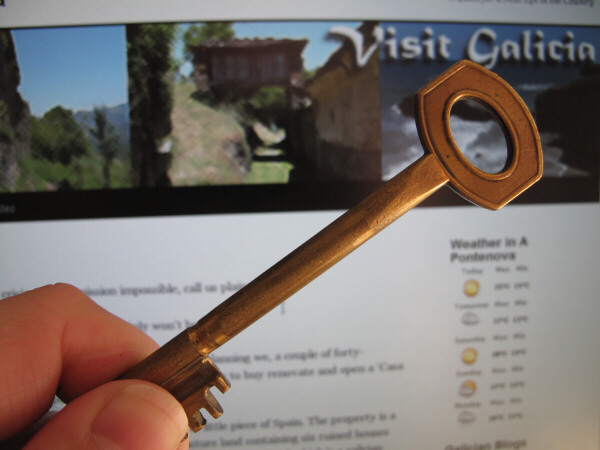
The notarios job is to read the entire contract (a legacy from the illiterate days of Spanish peasants) and ensure that she/he is happy that both parties understand and that nothing looks untoward. Just audible over the radio, she rattled through the contract at speed-reader pace, pausing momentarily to pronounce our English address, causing much mirth. Signatures from the seller and ourselves sealed the deal and we were handed the key to the property, somewhat unexpected as we didn’t think that there was one.

The Ceremonial Key

For better or for worse we were now Spanish property owners, on the longest day, in 2010.

We decamped with Inma, Julio, Ramon and Rachel (still in tow with Ramon) to a local cafe for a celebratory coffee and within twenty minutes our new friends had left to go about their business leaving us alone, deed done, to contemplate our next move.

The beaches beckoned (we didn’t know that it was high tide) so after calling at a local supermarket for bread, cheese and fruit we set the satnav for As Catedrals and a celebratory lunch. A granite bench on a windswept cliff top in early summer was where we ended our quest for a new place in Spain and started the long path to renovating our Casa Rural, Trece Liñeiras.

All that remained was to take the thirty minute drive to the house and use our ceremonial key to open the door for the first time. As I turned the key in the stable door, slid the sneck, and pushed it open I looked to my left to where a small hole had been carved into the stone. There sat another identical key, Carlos’s key, we both shrugged our shoulders.

It is the Galician way!

Posted in Background, The House in Liñeiras | Tagged , , | 1 Comment

Beans, beans, the musical fruit

Ask any holiday making Spaniard why they are in Galicia or Asturias and within the top three reasons for their journey they will certainly list the cuisine. Whether it is the delicious fresh seafood, the fruity and crisp Albariño, the Empanada de Atún or the Tarta de Santiago everyone is in agreement that the chefs of the north know how to cook.

We went over to Spain last weekend, a whistle stop trip to meet up with an architect that we’ve had doing an architectural survey of the house, and to let my Mum have her first look at the house in its current pre-building site state.

We stayed at Hotel Casa Paulino in Taramundi (over the border in Asturias) because it is cheap, only ten minutes from the house, and good value for money. While we were there we took a couple of evening meals in the village. After a couple of trips we’d already worked out that a starter and a main course each was a sure-fire way to indigestion so our new plan is to share a starter and then have a main each. While this would probably lead to you being thrown out of many English restaurants, the ‘tapas’ mentality of the Spanish seem to accept this as normal practice.

We had a fantastic starter one night, shared between the three of us, and for just 10,50 €, a ‘Selection of Asturian Cheeses’. They arrived on a wooden cheeseboard with six big chunks of cheese, each sitting atop a slice of apple and centred with a small jar of the most fragrant and sweetest honey you could imagine. The waiter suggested we start with the mildest cheese fist and work our way to the strongest, taking a piece of apple between each to clear the palate. We’d eaten three of the cheeses before I remembered to take the photo below.

What's left of a Selection of Asturian Cheeses

The cheeses are made with either cow, sheep and goats milk with a diversity of flavours and all made in unique ways with unique ingredients. Locals say that the taste varies from sheep-to-sheep and goat-to-goat and each cheese taken on elements from its environment including the caves where the strongest Cabrales are kept to mature.

By the time that the three of us had enjoyed the cheese, honey and fantastic local bread we were hoping that the main courses would be less substantial, or there would be no hope of us finishing them.

While Amanda and Mum had ordered steaks (and massive chunks of meat they were), I’d gone for another very local speciality, Fabas con Almejas (beans with clams) in a lovely thick broth full of flavour.

Fabas con Almejas

This dish is an absolute delight. The meatiness of the local faba beans, the freshness of the clams and the mixture of stock ingredients that make up the broth. All served together in a big tureen with crusty bread. But there were repercussions, as the poem says;

Beans, beans, the musical fruit.
The more you eat, the more you toot.
The more you toot, the better you feel.
So let’s eat beans for every meal!

Posted in Food & Drink | Tagged , , , | Leave a comment

The eve of the big day

We arrived in Galicia on the evening of the 20th June, cutting it fine as it was one day before we could lose our 10% deposit. But with the completion scheduled to happen on the 21st, the longest day, and with our feet on Galician soil we were confident.

There had been tremendous rains in the preceeding week, and after finding a large part of the main road from the airport to Ribadeo washed away and replaced by a mud track (down which everything including HGVs were travelling), we decided to call on the house and make sure that we weren’t now buying a pile of rubble.

As we parked up we caught our first glimpse of Carlos, the brother of the vendor, who had happily been growing potatoes and vegetables on the land for the last twenty plus years. He was outside the barn with his aged and moth eaten donkey harnessed to a cart which was laden high with straw, boxes and a bedstead. Amanda went to talk to him and he took off his bandana to mop his brow and make himself presentable.

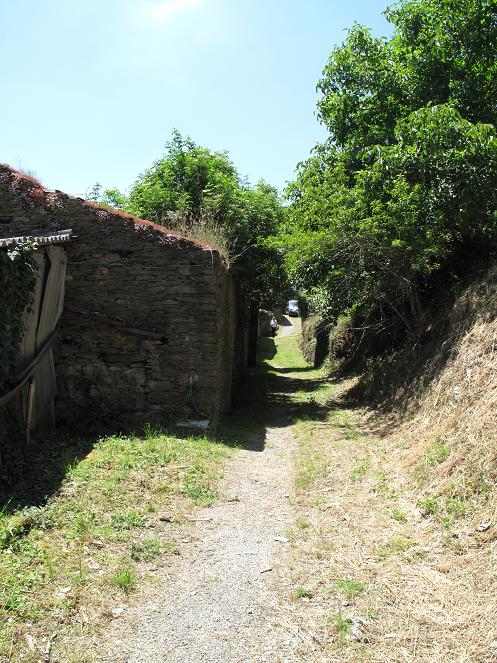
The thoroughfare, where visitors arrive

It emerged that his sister had told him that the house would be sold tomorrow and that he had to remove all of his ‘stuff’, a task which he appeared to have left until the very last minute. He asked Amanda about whether he need to dig out his already sprouting potato crop. ‘No, that’s okay, leave them and harvest them when they are ready, we don’t intend to do anything with the land until later in the year.’ There was a tear starting to form in the corner of his eye, it looked like one sentence had lifted a massive weight from his shoulders. He wouldn’t starve this winter.

‘And what about my car, can I leave it in your garage?’, ‘Yes’ replied Amanda. Feeling more confident he went for the third favour, ‘What about my donkey, can I leave him on your land?’. ‘Sure..’, said Amanda, ‘..until later in the year when we start work’. Then the last question, the one that he was obviously really nervous about asking but was the most important to him. ‘At the end of the summer can I cut your grass and take it as hay?’. Result for us! ‘Yes’ said Amanda, trying to hide her delight. For allowing a few small favours we were going to get the land tidied free of charge at the end of the summer.

Then our first neighbourly visitors arrived, and tried speaking to me to which I awkwardly responded using my very rudimentary Spanish and shouted to Amanda rescuing her from her conversation with Carlos.

‘Are you buying this house, we understand you are opening up an old peoples home?’. The Galician chinese whispers had been working overtime. ‘Yes and No’ said Amanda, ‘We buy the house tomorrow, and then we are going to develop it into a rural hotel’. This met with smiles, I am not sure whether they were happy at the prospect of a small hotel in their village or just laughing at us. ‘Very good, that will be perfect’. And then, in this most Catholic of countries, the typical Spanish second (although usually the first) question ‘And do you have children?’.

When we responded in the negative there was a look of pity on their faces, I felt myself being looked up and down as potentially ‘inadequate’, and then Amanda was stared at with pity (at having an inadequate husband). ‘Ah, that’s a shame!’ they said as a couple.

As they pulled away in their old Mercedes with sun dulled red paint neighbour number two approached the property from the other direction, this time with two children in tow. ‘Are you the new owner?’, she asked me (so I was told later by Amanda). My good wife rescued me for the third time in ten minutes. ‘Yes, yes we are’.

‘And do you have children?’ said the woman, ‘No’, Amanda responded. It was a conversation killer and it was at this point that I became concerned that she’d offer us one of hers, or at least organise a village collection to get us one. Childless, I felt almost guilty as she shuffled off two grandchildren in tow, one picking his nose and the other banging two stones together with no particular rhythm.

With this local fascination with children, perhaps we should be converting the house into an orphanage?

Posted in Background, The House in Liñeiras | Tagged , , , , | 1 Comment