But what is actually for sale?

Our Immaculate gestoria was in place but there was one thing missing, a traditionally English thing but something that the Spanish couldn’t care less about, a full survey. We explained to Inma that we’d really like answers to a few questions;

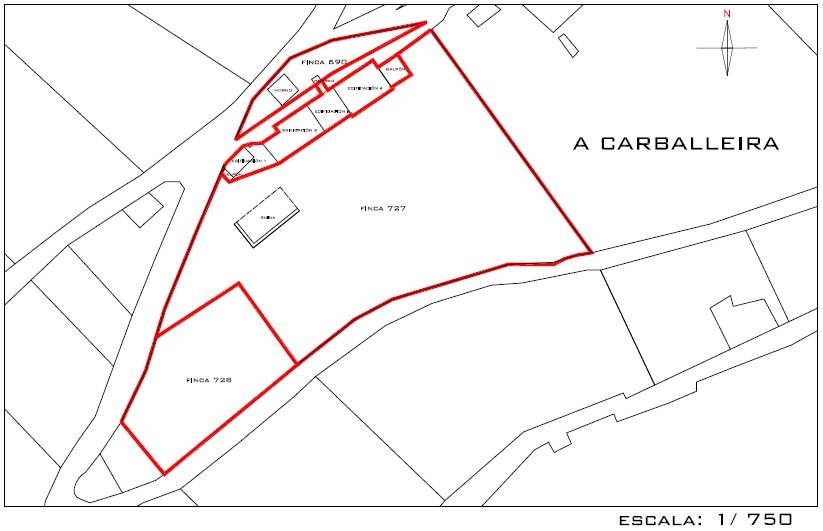
  • What land we were actually buying (the agent seemed pretty vague as to what was in the sale) ?
  • What was the condition of the property (beyond what we could physically see)?
  • What services the land already had supplied (utilities)?
  • Whether there were any local plans for developments in the area?

Inma humoured us and found us a local surveyor in Ribadeo who was contracted and sent to the house armed with theodolite and tape measure. Within a couple of days his report, for want of a better description, arrived with three pages of text (in Spanish), lots of photographs of the house in the sunshine (which was nice because we’d only really seen it in the rain), and a nice plan (see below) showing the extent of the land that comprised the titles on the market.

Amanda dedicated her time to the text, while I looked at the pretty pictures and the plan. I knew that there was something ‘interesting’ on the way when after thirty minutes of consulting the online Spanish dictionary  her preamble consisted of ‘Right then…’. For this is one of Amandas ‘I’m being serious’ phrases.

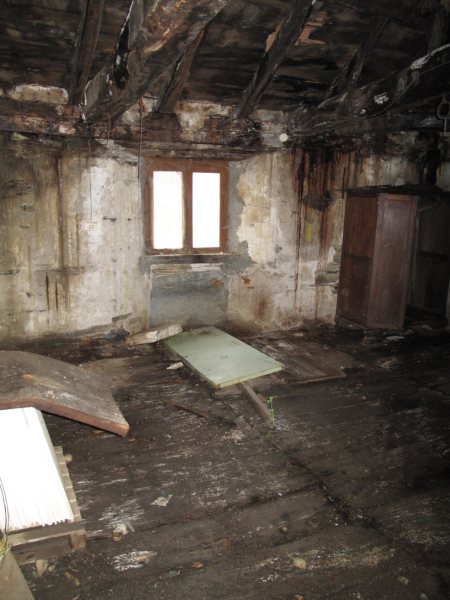
Basically, and without too much embellishment, she told me that the surveyors report said that the house needs a new roof, new internal floors, new doors and windows, sanitation, water, electricity, the ruined houses are overgrown, but on the whole it was fairly sound.

There were ‘no flies on this surveyor’.

I consoled myself with the fact that my 550€ had bought us some sunny house photographs and site plan. At the end of the day the words were only for Amanda anyway.

Now I know why the Spanish don’t bother with a survey!

Posted in Background, The House in Liñeiras | Tagged , , | 1 Comment

Call of the Camino

Mention Galicia and many peoples first thought is Santiago de Compostela the ultimate destination for the caminos (Way of St James) which work their way through the autonomous region. Travel to Galicia in the summer and it will be impossible to miss dishevelled, bearded, sandal shod, rucksack carrying, scallop shell wearing (resembling the setting sun) pilgrims testing themselves to the limit to reach the final resting place of St. James, the only Saint to be buried west of Rome.

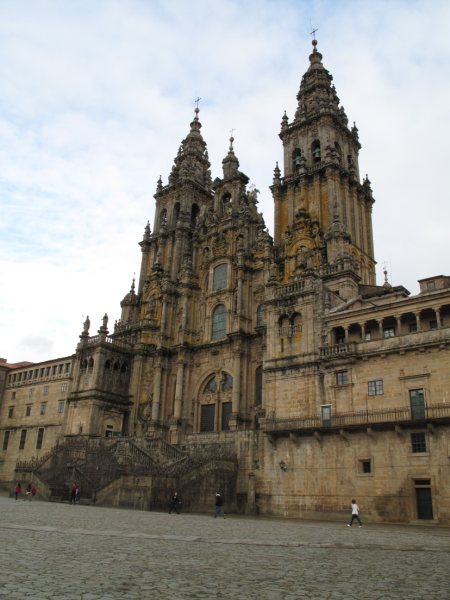
Pilgrims Goal - Santiago de Compostela Cathedral

People walk the caminos, for there are many, for many different reasons. For many it is for a religious pilgrimage, the reason why people have been walking the routes for over one thousand years, but for others it is a holiday, a challenge, a family bonding experience, or just something different.

There are twelve main waymarked routes to Santiago de Compostela starting as far away as Paris, Geneva, Arles, Seville, Granada, Valencia, and Barcelona. They are all a fair old ramble with the Geneva route chiming in at a massive 1,900km. To officially qualify as having made a pilgrimage you need to walk at least 200km and complete your journey in Santiago de Compostela and have your certificate stamped at several points along the way.

One such pilgrim in 2005 was Robert Mullen who has written a blog about his experiences to publicise his new book ‘The Call of the Camino’. He walked the Camino Francés from the foothills of the Pyrenees to Santiago de Compostela, a journey of around 500 miles, through all the delights that Northern Spain has to offer. I’d urge you to take a look as the blog is well written and very nicely illustrated with Roberts’ own photographs.

The Northern Route, originally made as an alternative to the Camino Francés to avoid the Muslim occupied areas of Spain in the middle ages,  comes within 30km of our house in Liñeiras as it passes from Ribadeo to Mondoñedo to Abadin.

2010 has been a special year for pilgrims, a Holy Compostellan Year (25th July falls on a Sunday) with the number of people walking the routes rising to around 200,000 from the annual total of around 100,000. The last special year was 1993 and the next will not be until 2021 then 2027 and 2032. Recent advertising by the Xunta de Galicia has been very successful when you consider that only 690 pilgrims officially completed a Camino in 1985 compared to 145,877 last year (2009).

So if you fancy a bit of a ramble, followed by a few days of luxury at our Casa Rural, start making your plans for 2012 or 2013. Hot showers, good food and pampering guaranteed.

Posted in Places to Visit | Tagged , , | Leave a comment

The size of the task

Here is a video made up of just over seven and a half minutes of still images and some movie footage shot on a digital camera. It shows the house and all its associated ruins including some photographs of inside.

It comprises images from trips in March and June 2010 and gives a good overall impression of the state of the property, before any work starts. Click play to start the video – there is no sound so it is work friendly;

[mediaplayer src=’http://www.visitgalicia.co.uk/wp-content/uploads/2010/08/HouseatLineiras.wmv’ autoLoad=1]

Posted in Background, The House in Liñeiras, Video | 1 Comment

‘To buy or not to buy’, that was the question

All of a sudden things had become real, very real. We were moving into the terrifying transition phase between the romantic notion of an idyllic Spanish house in the country, and the handing over of a large amount of hard earned cash for a ramshackle wreck on a Spanish hillside.

Dream or Wreck?

We’d spent many days and nights dreaming about what our ideal property would be like; the size, the space, the views, the renovation work, the final elegant look, and opening the doors to our first paying guests, but up until now it had all been a dream. We had been shown a property which we both instantly knew was right for us and our project, and now we had to make a decision as to whether we were being realistic or not.

I was quiet for the majority of the trip back to the UK, iPod in ears, eyes closed, £ and € symbols racing through my mind as I tried to make sure my heart and head were synchronised for what was the largest decision of our lives. I know that sat next to me Amanda’s brain was going through exactly the same turmoil, we didn’t need to speak. It is amazing how sometimes I can know exactly what is going through Amanda’s mind, and on other occasions my mind-reading powers totally desert me.

On the drive back from Stansted to Yorkshire the final decision took just four words.

Mine came first, ‘So then’ I said.

Two seconds later Amanda responded ‘Yes’ to which I quickly replied ‘Yes’. We both grinned at one another and my concentration returned to the A1.

There was still some work to do before we could make an offer.

What we had to do quickly was find ourselves an gestoria, an essential ally in the Spanish house buying process. A gestoria is basically an under-solicitor (although ours in a qualified solicitor and runs a separate legal practice) who helps you through Spanish bureaucracy, whether that be buying a house or a car, or simply dealing with utilities or the council. The gestoria is from an age when the average Spaniard couldn’t read or write and couldn’t be bothered with the trappings of administration for fear that it would interfere with feeding their pigs or chickens. Despite the increase in literacy, and possibly also due to the exponential increase in ‘red tape’, the gestoria has remained an integral part of Spanish life. Ours is called Inmaculada (Inma for short) which as you’ve probably already worked out means immaculate – how could we go wrong?

Posted in Background, The House in Liñeiras | Tagged , , | Leave a comment

Our third visit – part two – nirvana uncovered

The third night of our visit found us straying outside Galicia and staying in the fantastic Asturian village of Taramundi at Casa Paulino, a great little hotel which was recently renovated and which has excellent views at 38€ per room per night.
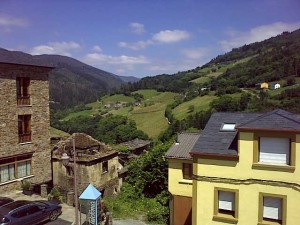
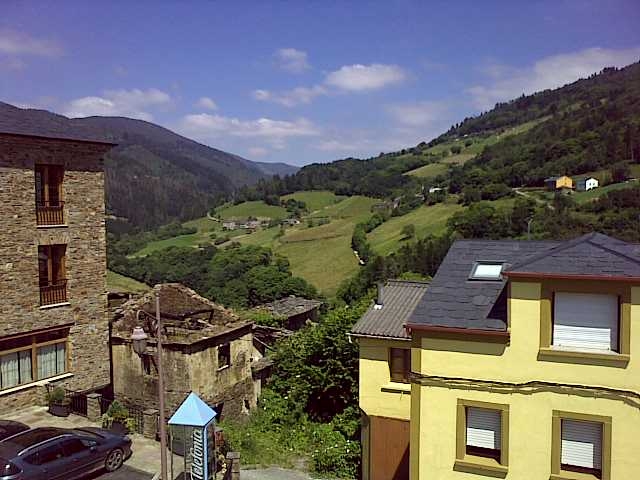
View from Casa Paulino

On our late arrival, after a long cross country drive, we met up with Ramon of Spanish Country Cottages and after a couple of beers hit a local hotel restaurant for Fabas con almejas(Beans and clams). It very soon became apparent that Ramon is far more comfortable a talker than he is a listener. His 100mph English, with a heavy Spanish accent, does take some acclimatisation.  What it shows is his great enthusiasm for the area, and despite us being a lot further east than we originally wanted he’d already sparked our interest in the Turia Valley, and everything that we now knew that it had to offer.

Three hours of listening later, with the occasional interjection while Ramon chewed a mouthful of beans, and we made our tired excuses agreeing to meet the following morning to see the long list of properties that Ramon, and his local ‘fixer’ Julio, had lined up for us. The morning seemed to arrive very quickly after a good night sleep, and at a very civilised 9:30, full of fresh coffee and pastries, Ramon introduced us to Julio who would be our driver and guide for the day. We immediately liked Julio, and despite him not speaking a word of English (although we suspect he understands more that he lets on),  he had the kind of face and demeanor that you instantly trust. He looked vaguely like my Dad (who passed away in 2004) and had the same open demeanour and friendly grin. He also told Ramon to ‘be quiet’ on several occasions, although not quite so politely.

The double act continued as we hit the road in Ramons hired A-Class Mercedes, Julio at the wheel, driving like a Spaniard. Ramon and Julio have properties throughout the Turia Valley which spans Galicia and Asturias but we’d made it clear to Ramon that we were only interested in Galicia, so we headed through A Pontenova, on to Vilameá and then to a small dispersed valley village called Liñeiras.
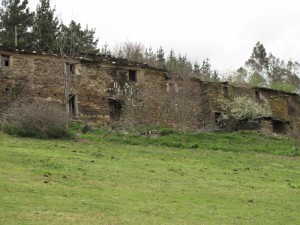
First glimpse of Number 13

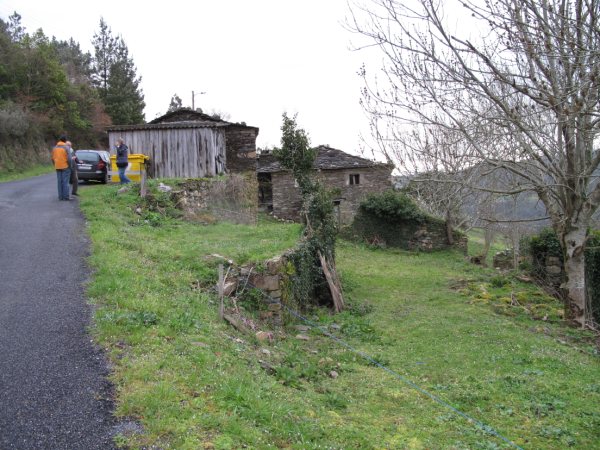
We drove along the south edge of the property in question, around a tight right hand bend, and up a steep road to see the property from the side.
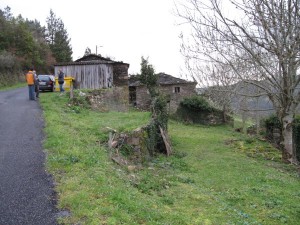
From the side

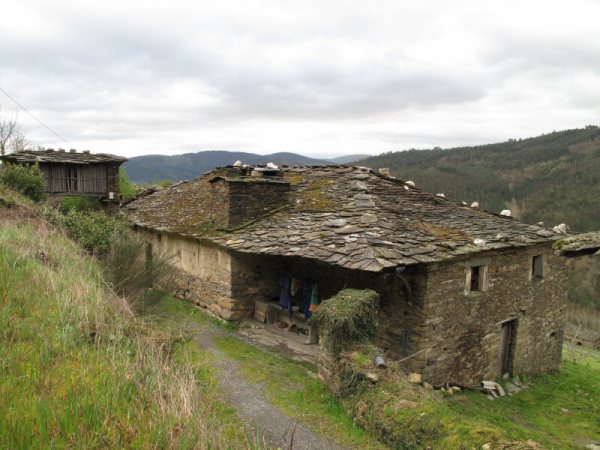
And then we parked up, got out of the car and saw the full glory of the house from the main entrance to the land.
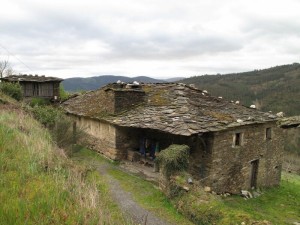
Main house

There was no shaking of heads, no pulling of faces, no negative telepathy, just big wide grins. It was Ramon and Julios first property of the day and already they had played an ace, pulled a rabbit out of the hat, scored a screamer from outside the box! This was exactly what we’d been looking for, and our new ‘best friends’, the double-act from the Turia Valley, had found it for us at the first time of asking.

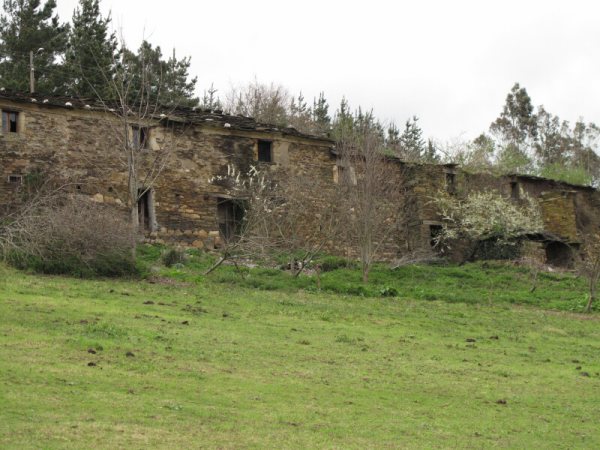
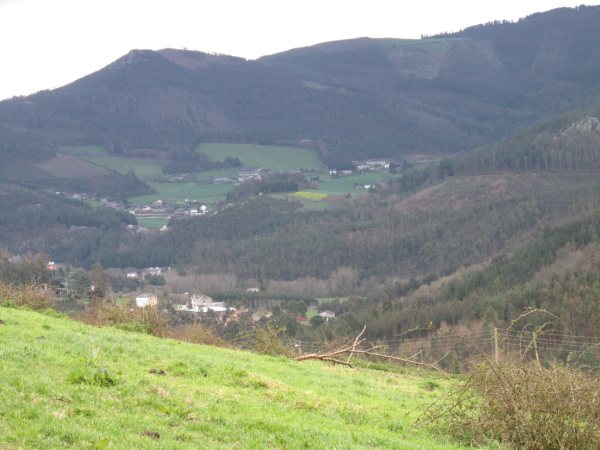
What they were showing us was ’13 Liñeiras’ (trece pronounced tre-th-ay),a complex of houses and ruins set into the quiet rolling hillside with beautiful views down the valley and across the forests. Even in March, with bare trees and any wildlife with a brain still asleep or sunning itself in Africa, you could tell that it was a special spot. There was one main house, single storey on the top side and two floors down the slope which had a reasonable roof (only half a dozen holes) and faced south. Next to it were two further houses, in ruin and overgrown with vegetation, and beyond those a large  ramshackle lean-to.
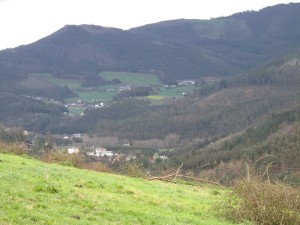
Valley view from the house

Opposite the main entrance to the house was another ruined house set into the banking which contained a stone bread oven. Attached to the main house was a beautiful horreo which rose three metres in the air and spans the track which runs down next to the house. There is also a barn (roof intact), and two further ruined houses about twenty metres away from the main house. The land area was over 7,500 square metres (almost 2 acres), gently sloping and of good arable standing.

We felt like we’d hit the jackpot. If this was the first, had they gone all out, or were they saving even better for later?

We must have spent over an hour exploring and investigating before being ushered away to see another half a dozen great properties. Some of the others had nicer houses, or more land, or even better views, but none of them had the full package that ‘trece’ had to offer.

Now we had some serious thinking to do.
Posted in Background, The House in Liñeiras | Tagged , , , , , , | 1 Comment