Licensed to build…well, renovate

With the sudden arrival of a Galician heatwave (it touched 35°C at one point this week) and the impending onslaught of tourists escaping the oppressive heat of central Spain, you would expect that the building contractors of A Pontenova are looking for a bar to quietly secrete themselves into until the cool of the autumn.

But far from it.

We now have, in hand, three written quotations to undertake the works on the barn which the architect, who cannot be named, tells us that we can get on with under our obras menores (minor works) license. This license finally arrived with our solicitor some sixty days after it was reportedly posted from the councils offices just 30km away and we now have just four months to start the works,  as a six month commencement clock starts ticking from the date that the license was issued, rather that then date that we received it.

That said, our architect tells us that she has never, in eleven years as an architect, known any local council to take action against an applicant for not starting within the prescribed time. We had supected as much, but it does make you wonder why they put a time limit on the notice.

At the moment we are allowed to;

Re-roof the barn with irregular, rustic tiles retaining the interlocking tile roof line

and;
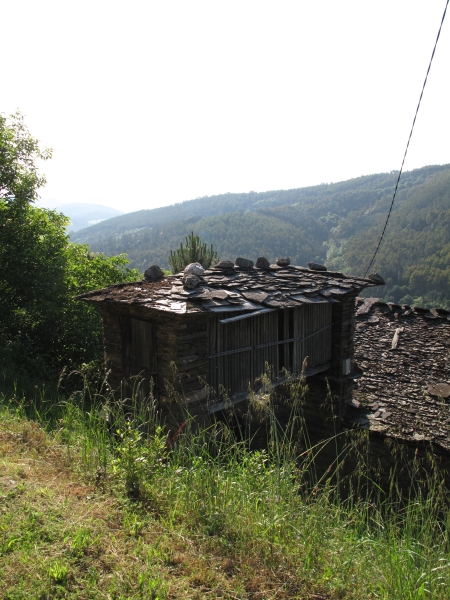
Renovate the horreó including replacing the roof (if necessary)

The quotes vary widely for these works but the cheapest two are about 10% apart from one another. The third is massively more expensive and we can only conclude that this is because the builder in question has a full order book and has decided to put in a ridiculous price to ensure that he can employ more staff should we choose him for the work.

We now need another trip to talk to the two builders who are in the frame to make sure that they are quoting on a like-for-like basis, and to do a bit of final price negotiation before appointing one of them to get on with Stage I of our development.

What a great excuse for a few days of summer sun, plates piled high with tasty fresh seafood, and some nice chilled Albariño. I think we’ll try the newly opened Manchester to Bilbao route with EasyJet.
 

Posted in Barn Renovation, The House in Liñeiras | Tagged , , , , , , , | 1 Comment

Twelve things we’ve learnt in the last twelve months

The summer solstice, the longest day, June the 21st, will forever be associated in our mind with the day that we completed the purchase of our house in Galicia. Today sees the first anniversary of us sitting in the offices of a Ribadeo Notario surrounded by a multitude of interested parties all waiting for their slice (of varying sizes) of our hard earned cash as we received the key to our pile of rubble on a remote Galician hillside.

Some of the time it feels like it was only yesterday, but on the daily commute to Salford it feels like a painfully long time with very little to show for our efforts and our cash.

It has been an interesting roller-coaster journey over our first years, from elation to despair and back. So what are the twelve key things that we’ve learnt during our first year of overseas property ownership? 

  1. Forget extended legroom on EasyJet. Sit as close to the front of the plane as you can, and then you’ll be first off, and hence first in the queue at the car hire desk. It will still take twenty minutes to get your keys but you’ll save yourself upwards of an hour of waiting and tutting.
  2. The laws on smoking in the workplace don’t appear to apply to Notarios.
  3. When trying to estimate how long a bureauratic process will take; think of a reasonable period of time, then triple it and add three months.
  4. When your new Spanish neighbours find out that you don’t have children they will offer condolences rather than congratulations.
  5. The more important the documents, the longer it takes the Spanish postal service to deliver them.
  6. Guttering is an infrequently accepted optional extra in Galicia. Surprising for a region with the same annual rainfall as Manchester.
  7. It is guaranteed that as soon as you place an order for Euros with your currency broker the exchange rate will improve.
  8. The visual appearance of food is inversely proportional to the way it tastes (e.g. percebes, scorpion fish pate, cabrales, spider crab, etc).
  9. Speaking a little Spanish opens doors much more easily than waving your arms about and shouting in English.
  10. It is impossible to find something that isn’t taxed in some way. The government get their little slice of everything, or at least everything that is declared!
  11. The more you panic, the more laid back your gestoria will get, and the longer it will take them to answer your e-mails.
  12. While you are in England your Spanish neighbours will continue to use your property as though it is their own, keeping their livestock in your barn, hanging their washing on your line, and harvesting your fruit.

One year passed as long distance Gallegos, and looking forward to our second year of ownership.

Posted in Local Life | Tagged , | Leave a comment

He’ll not see Christmas

The death of Carlos’ donkey is not the end of the tale of livestock at Casa Liñeiras, for now we have a new squatter.

I use ‘we’ in the loosest of terms for the likelihood is that the animal we have actually belongs to Carlos, and its detection caused a bit of a furore.

It has now become tradition when first visiting our pile of Galician stones to check over the inside and outside of the house and make sure that nothing had fallen off, or in, or down, and to ensure that we’ve not gained any additional redundant electrical appliances.

Last week as we approached the property I could see that the top half of the main stable door was open, which was unusual. I entered and went to the fuse box to switch on the power so we could have light. Flipping the switches the 40 watt bulbs flickered to life to be greeted by grunting from deep in the bowels of the house. Alarm bells immediately started to ring.

I shouted to Amanda ‘there’s something in here’ and followed the sounds down into the old animal pens area of the house, with some trepidation.

Deep in the Bowels of Casa Liñeiras

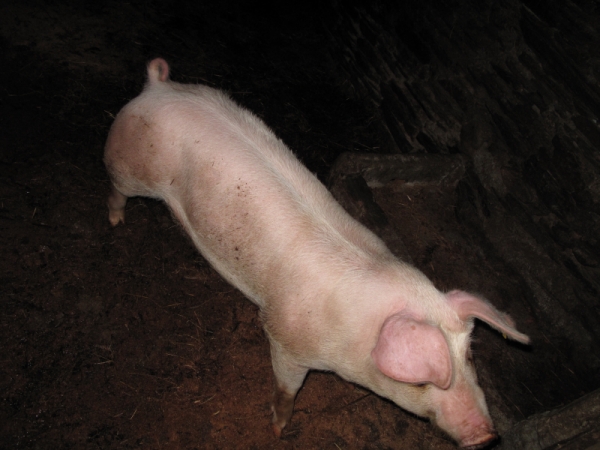
As I got closer the noises got louder and then within one of the animal pens I got my first site of our new resident, a big pink pig, who we’ve not named for fear of developing some kind of bond, knowing full well what his fate will be in a few months time.

The pig thought it was food time, and was going crackers, grunting and snorting and trying to jump up to say hello, managing to get his trotters (are they called that when the animal is alive?) about an inch off the floor with each attempt.

Our new resident

The immediate, and very English, reaction was to find Carlos and insist that he remove his pig from our property, but after calming down for a few minutes we came to the conclusion that he was doing no harm, and that it would cause more problems and bad feeling to get him removed than was to leave him be.

After our discovery we mentioned our lodger to several people we encountered on the rest of the trip. With the exception of our English neighbour David, who was aghast like us, the reaction was a dismissive smile or a giggle. ‘It is the Galician way’.

In any case, we all know where this pig is going to end up, and probably in the not too distant future. Maybe Carlos will thank us for his use of our house with some nice smoked paprika seasoned chorizo. One thing is for sure, ‘Babe’ will not see Christmas.

Dammit, I’ve given him a name!

Posted in The House in Liñeiras | Tagged , , , , , | Leave a comment

Percebes: Food of the gods

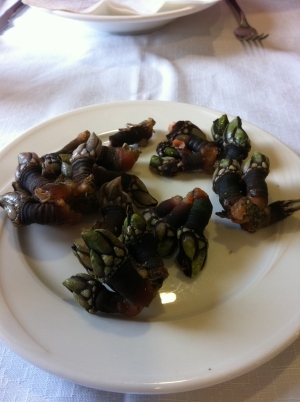
In Greek mythology ambrosia is the food of the gods, up there alongside nectar as the most heavenly of consumables. In Galicia the ambrosia equivalents are percebes, or as the English would call them, goose neck barnacles.

Despite their unappealing, frankly ugly, appearance and the finger numbing method of consumption, these tiny morsels of pure undistilled rugged coastline are as delicious as they are dangerous to harvest from the wave crashed cliffs of the costa da morte.

I was introduced to percebes by none other that Jeremy Clarkson, not personally, but through a TV programme which showed him being winched down the Galician cliffs in a wet suit clutching a small net and a rock hammer. When he’d been battered by the Atlantic waves and clambered back to safety he cooked up a handful of percebes on a primus stove and waxing lyrical.

What really puts you off is the price, these things can command an outlay of up to 100€ per kg, so they are not something that you’d eat on a daily basis. On an early trip to Santiago de Compostela I tried 10€ worth in a restaurant near the cathedral and was instantly hooked.

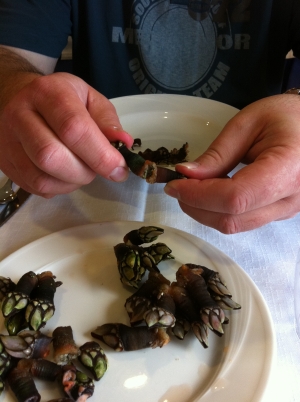
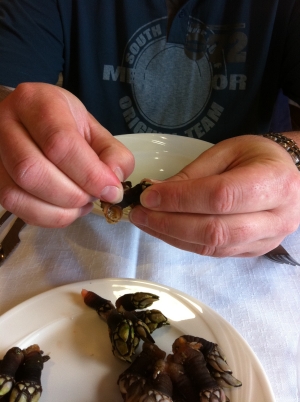
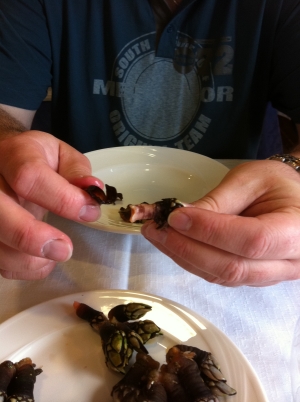
When we went out to Galicia in May we were recommended (thanks Stephen & Kay) a restaurant in Rinlo (ten minutes west of Ribadeo) called ‘A Confradía’ and on being seated we were brought a plate of percebes ‘on the house’ while we waited for our main course to be cooked (more of that in a later blog). They aren’t the easiest food in the world to eat and you have to put in quite a bit of work for the reward. But here is my non-expert eating advice;

A few Euros worth of Percebes

Split the clumps of percebes into individual pieces

Tear the black sheath near the claw end

Remove the sheath and eat the flesh inside

Each year Rinlo holds a Percebes festival where all that is served is this local delicacy. Although there are inevitably some people who dislike percebes, believe me, they are well worth trying because if you like them, you’ll love them!

Posted in Food & Drink, Local Life | Tagged , , , , | 2 Comments

Sad news from Galicia

As you may have guessed by my lack of blogging we’ve been out in the Turia Valley for a few days holding various meetings and trying to sort out a number of issues. There will be more on these in later blogs and some of them are getting rather complex.

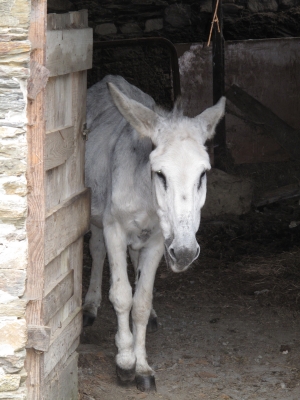
One of the reasons for the visit was to meet up with our neighbour Carlos, and find as nice a way as possible to ask him to remove his donkey from our barn, in readiness for our starting work under our recently obtained ‘obras menores’ licenses.

On arrival at the property on Tuesday of last week there was no sign of Carlos. His battered old Seat Ibiza was still parked in our garage, his tools were strewn across the path and against the house, but there was no Carlos. We shouted a couple of times, as he has a knack of secreting himself on the property, but all to no avail.

After a quick walk around to make sure that nothing had moved or fallen off since we were last there in January we also noticed that there was no sign of the donkey, the one which hates me. The natural conclusion was that Carlos was with the donkey, working some other land. After waiting for an hour or so we decided to head back to the Concello in Pontenova to meet with yet more officials.

As we left the property a small dog almost ran under the wheels of the hire car and as I brought the car to a stop the dogs grinning owner indicated for us to wind down the window for the obligatory chat.

In England I’d have expected the opening words to be ‘you nearly killed my dog’ but we were in España and instead of aggression, they were ‘are you the English?’

After explaining who we were, what we were doing with the property, that we didn’t have any children, and that we were looking to become permanent residents, the elderly gentleman told us that he was called Miro and that he lived next-door-but-one to us, in the big green house.

Amanda had done all the talking so far as I just grinned and tried to follow the conversation, but as it turned out that he was a neighbour, and quite friendly,  I felt that I could ask after the donkey. In my finest castillian I asked ‘Donde esta el burro de Carlos?’. The response came back ‘Se murió’, he’s died!

El burro es muerto

Apparently he’d died the previous week and Carlos was distraught, our neighbour had thrown himself into his work to try and forget about his loss and was chopping wood for twelve hours a day. There was only one action left for us.

I turned the car round and headed back to the house. We now had to check the land for freshly disturbed soil for there was every chance that Carlos would have buried the beast on our land. A ten minute walk around the perimeter and we were sure that the dead donkey was elsewhere, or extremely well hidden.

It’s a sad end for Carlos, and his great white donkey, but at least it means that we don’t have the guilt of displacing an animal that had spent its entire life on our land, and in our barn.

Posted in The House in Liñeiras | Tagged , , | 1 Comment