Always time for a Spanish holiday

Colin Davies (Thoughts from Galicia) blog yesterday was all about tuesdays Spanish National day, a national  holiday across the whole of Spain where everything vaguely commercial grinds to a halt, families congregate, and parties are had across the land.  As Colin points out, he is not sure if such a National Day exits anywhere else in the European Union, but it is certainly popular in Spain.

There isn’t a National Day England where the closest thing we have is St Georges Day, celebrated by the sporadic unfurling of the flag of St George, and cheap beer promotions at any pub left open as the recession continues to close them at an astonishing rate. No one in England gets the day off for St Georges, and it’s even the case that some of the ‘political correctness’ brigade would like to see any recognition of the day stopped as it could be seen as racist. Imagine the reception that such a suggestion would get in Spain?

The Spanish have overt national pride, but what they also have is a mass of public holidays which put our measly eight to shame. Every region of Spain has a maximum of fourteen public holidays, nine of which are national and the remaining five are regional. Galicia takes full advantage with its own fourteen, which are;

January 1 – New Year’s Day (national holiday) – Año Nuevo
January 6 – Epiphany – Día de Reyes/Epifanía del Señor
March 19– St. Joseph’s Day – San José
March or April – Maundy Thursday – Jueves Santo
March or April– Good Friday (national holiday) – Viernes Santo
May 1 – Labour Day (national holiday) – Día del Trabajador
May 17 – Galician Literature Day – Día das Letras Galegas
July 25 – Saint James. Galician National Day – Santiago Apostol. Dia da Patria Galega
August 15 – Assumption (national holiday) – Asunción
October 12– Hispanic Day (national holiday) – Día de la Hispanidad/Fiesta Nacional
November 1 – All Saints Day (national holiday) – Día de todos los Santos
December 6 – Constitution Day (national holiday) – Día de la Constitución
December 8 – Immaculate Conception (national holiday) – Inmaculada Concepción 
December 25 – Christmas Day (national holiday) – Navidad

But the festivities don’t usually stop there. Where these fall on a Tuesday or Thursday then the preceding Monday or following Friday are also seen as ‘fiesta’ days where people either take vacation days to make a long weekend or simply have a ‘duvet’ day.
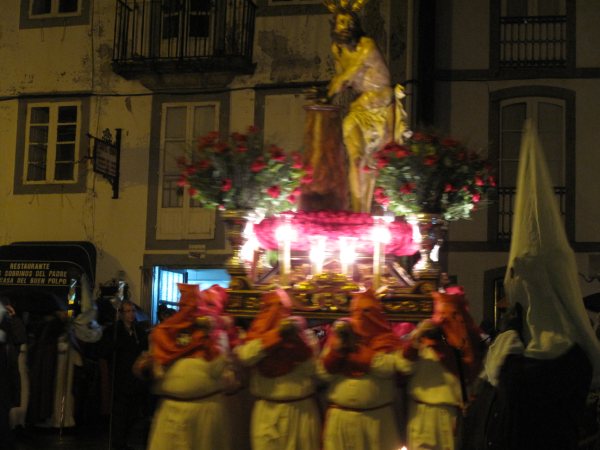
Festival Celebrations

On public holidays you can expect the following (taken from here);

  • All public offices close
  • All shops and 90% of commercial centers close
  • About 60% of bars and restaurants are open as normal
  • Reduced public transport services
  • Museums remain open
  • Extended opening hours at many attractions
  • Reduced medical and emergency services
  • There is the possibility of increased taxi fares and limited availability

In addition to these public holidays most Spaniards, except those involved in the tourist industry, take their vacations in August, some for the entire month. Central Spain empties with businesses closing for the entire month including shops and restaurants while their staff head to the cooler coast for some respite from the heat. This is the time when Galicia gets busy with the usually deserted roads heaving with Madrillenos (people from the nations capital) all looking for good food, great beaches and moderate temperatures. It is also the time when town and villages hold their Fiestas. Every small village around has their own day and own party, including Liñeiras (second weekend in June).

Spain is a nation which fiercely guards its holidays as time for families and parties and feasting and drinking. Now that’s what I call a civilised society!
Posted in Local Life | Leave a comment

The fine art of Spanish car hire

Anyone who visits Galicia is unlikely to be collected from the airport in the tourist busses commonplace in the south or east, and whisked away to their hotel for a week long stay. To see Galicia properly you will need to hire a vehicle, and car hire, with all of the associated extras can be very expensive.

When like us you’re saving every available penny, and hoping that the pounds do an adequate job of looking after themselves, car hire is a necessary evil which can really hurt the pocket.  

As we’ve regularly hired cars abroad we already knew not to accept the cars offered by partners of budget airlines, and not to wait until we were in the arrivals hall hoping to get the best deal, both play on their convenience and mean that you pay over the odds.

In my experience there are three main things to consider;

Insurance

Whenever you hire a car the cost usually includes the most basic level of insurance. If you stick with this alone you’ll probably have to hand over your credit card so that the company can swipe a refundable deposit (usually between 150 and 600 Euros depending on the level of car). Some take this as a payment and refund it, giving you issues with credit card cut-off dates and currency exchange fluctuations, and others just hold it without processing.

In addition to the basic mandatory insurance cover all hire car companies will try and get you to pay a Collision Damage Waver Excess (CDWE) insurance when you collect the car. This is usually in the range of £10 to £15 a day and can add a big chunk onto the overall hire cost. The advantage is that you don’t need to leave a deposit and any damage is covered, you just hand back the keys.

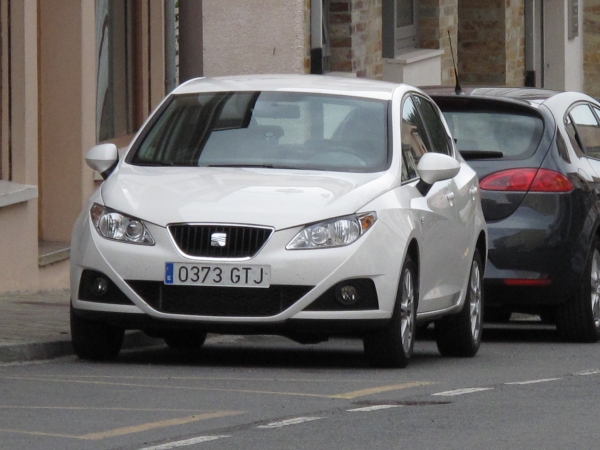
Car parked pre-bump in Taramundi

A car we hired with CDWE insurance got side-swiped while parked up in Taramundi village with no note left or any idea who’d done it. On return we just handed over the keys with no problems, but it would have cost us our deposit if we hadn’t had CDWE.

The second way is to get yourself trip or annual CDW Excess cover. We used insurance4carhire.com where we got an annual policy for the same price as a few days full cover, very useful if you are making multiple trips during a year. You still pay, and potentially lose your deposit, but claim it back from the insurer.

Car hire companies

These come in all shapes and sizes from your massive multi-nationals like Hertz and Europcar to the small single location independents. Rather than go direct to a single company you are almost always best using some of the car hire search engines to secure yourself the best deal.

We tend to go for a ‘compact’ or ‘intermediate’ car, avoiding the death-trap ‘tin cans’ like Ford Ka and Opel Corsa in favour of something with a bit more metal around you. The way that some Spanish can drive is akin to our ‘boy racers’ so it is worth giving yourself as much chance as possible should the unthinkable happen. Try the comparison sites like; moneysupermarket.com, holidayautos.co.uk, or comparecarhire.co.uk. Five minutes spent on a trawl could save tens of pounds a day.

Booking as early as you can seems to be the trick as prices rise the closer you get to departure date. It may also be cheaper to hire in Euros than Sterling, but keep an eye on exchange rates and factor in any credit card fees.

Getting and using the car

The pick-up is the crucial time. Make sure that any damage is marked on the pick-up schematic (unless you are using full CDW Excess insurance in which case…who cares?). On several occasions we’ve picked up cars which had clear damage, not marked on the schematics, and which would have cost us when we returned the car. What I usually do is photograph the damage and go back to the hire booth and ask them to mark on the schematic.

Not declared at pick-up

Also, check that the car has a full tank of fuel (we got two junctions down the motorway once before I realised we’d signed for a full tank and only got a half). Make sure that there is enough tread on the tyres (it is your responsibility).

Full tank at collection?

I know what it is like having just arrived and wanting to get on the road as soon as you can, but five minutes checking at pick up could save you hours of aggravation or a lot of money somewhere down the line.

Posted in Local Life | Tagged , , | Leave a comment

No horror in hórreo

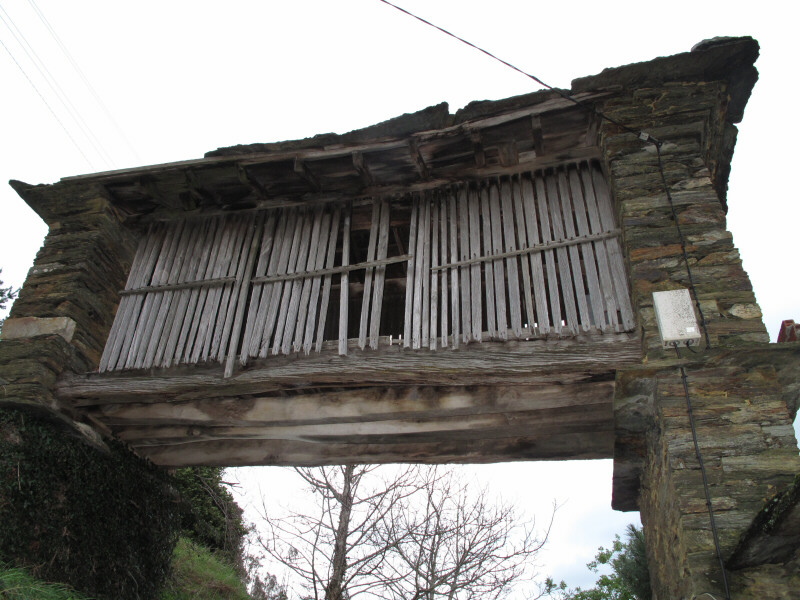
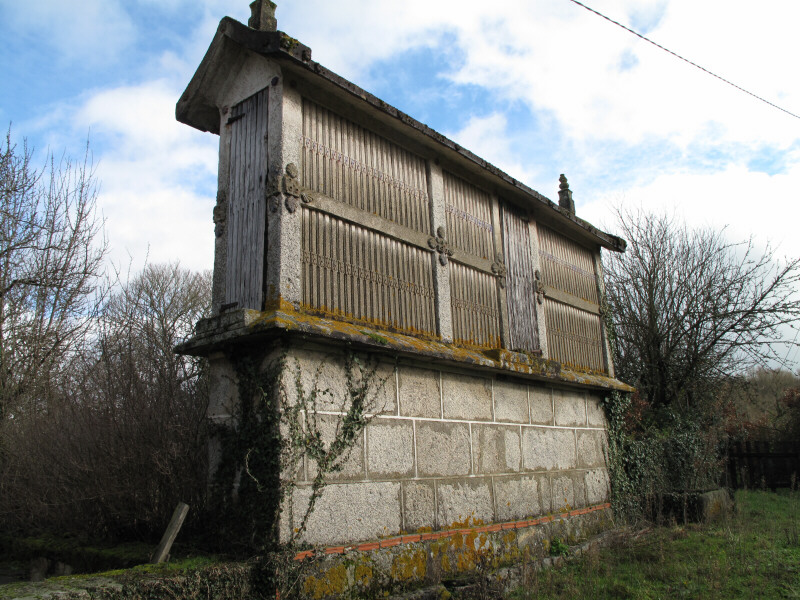
Something which sets Galicia, and for that matter neigbouring Asturias, apart from the rest of  Spain is the proliferation of strange looking square or rectangular vented buildings raised up on stilts, often with no visible means of access. The are the hórreo.

While you can see the odd one in suburban Madrid, and even as far as the costas on the south coast, these have often been bought from the north and then moved brick-by-brick to a new ‘false’ home. Galicia is the home of the hórreo.

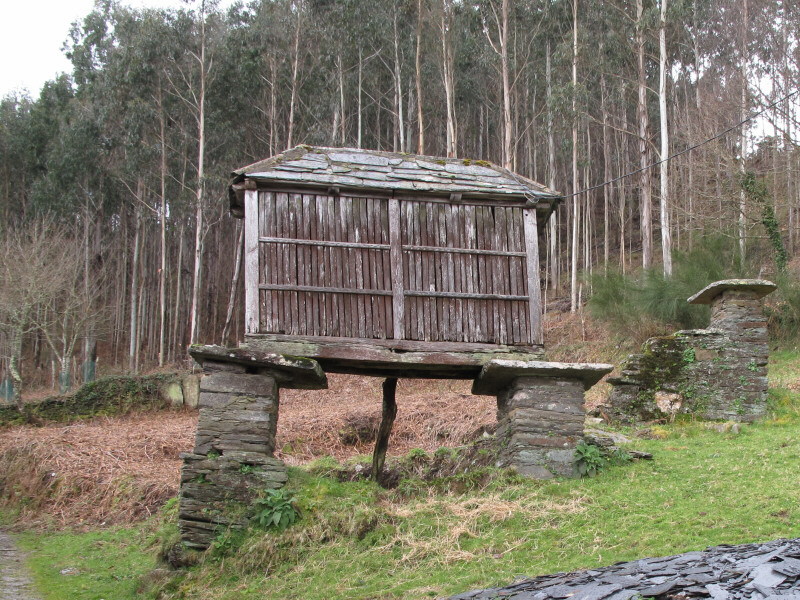
Our main hórreo

The hórreo, the north Western Spanish grain store is first recorded in the documentary evidence in the twelfth century. They can be any size from a metre or so long to the longest at a reported 35 metres in Carnota, near Ribiera. They are built out of stone or wood or both and were integral to Spanish life up until half a century ago.

There are hórreo elsewhere in Europe but there is a massive concentration in Galicia and Asturias and, as a pre-requisite for our house purchasing, almost all of the houses which we considered during our search had one. The property that we ended up with has two, although one of them is in a very poor state of repair.

Thanks to wikipedia for the following definition;

‘An hórreo is a granary built in wood (Iberia or Scandinavia) or stone (Iberia), raised from the ground by pillars (“pegollos” in Asturian, “esteos” in Galician, “abearriak” in Basque) ending in flat stones (“mueles” or “tornarratas” or “zubiluzea”) to avoid the access of rodents. Ventilation is allowed by the grooves in its walls. In some areas, hórreos are known as hórreu, horru (Asturian), horriu (Leonese), hurriu (Cantabrian), hórreo, paneira, canastro, piorno (Galician), espigueiro, canastro, caniço (Portuguese), garea, garaia, garaixea (Basque), orri (Catalan), stabbur (Norwegian), härbre or more precisely stolphärbre or stolpbod (Swedish), raccard ou regard French.’

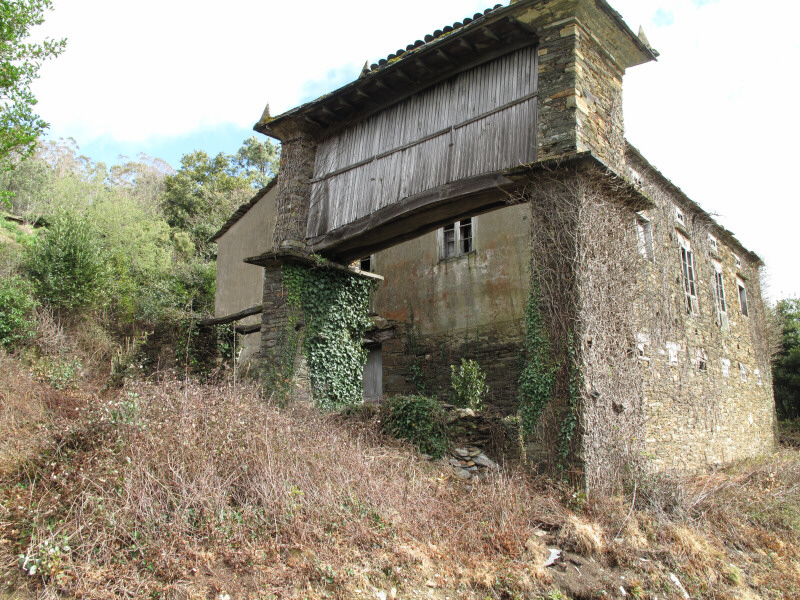
We saw all shapes and sizes of horreo on our house-hunting and there are just a few examples below (click the photos for larger images) ranging from the weediest and most insignificant at a property near As Pontes to the grand hórreo valued at around 20.000 Euros at the house that we nearly bought at O Paramo.

Weedy As Pontes Hórreo

Elevated Hórreo at a property near Monfero

Hórreo at one of Julios houses in the Tura Valley

Close-up of our main Hórreo

The beautiful Hórreo on a granite base at O Paramo, that we fell in love with

All hórreo in Galicia and Asturias which are in a repairable condition are now listed. You cannot remove or destroy them and they must be renovated in a sympathetic manner, for which there are grants available from the local and Galician governments. The size of the hórreo is indicative of the size and importance of the family that lived in the house.

We will certainly be renovating ours as part of the work on the main house and we will either end up keeping it empty as a talking point, or using it as a store for bicycles and fishing tackle. It is normal to have carved stones at the top corners of the pitched roof and I have a special plan for ours which will be revealed when I determine whether the regulations will allow me to do it.

Our second hórreo is borderline recoverable as it is in very poor shape with all of the roof and wooden structure lost to the elements many years ago. It is also quite close to the house and could block out the sunlight. We need to check on what we are allowed to do and then see what the architect suggests. Hopefully we’ll end up with something that looks at least as good as the restored hórreo at Casa Do Mudo, the Casa Rural where we spent our first night on Galician soil back in November 2009.

Restored Hórreo at Casa Do Mudo, Senra

Posted in Local Life, The House in Liñeiras | Tagged , , , , | 2 Comments

We’ve got squatters

We revisited the house at the beginning of September, our sixth trip in ten months. This time Mother was in tow, keen to see the pile of rubble that we’d acquired prior to our starting work on it. The main reason for the trip was to meet with Fernando and Luz, our University architects, and to take delivery of our site survey plans.

Since committing to buy the house, each trip had started in the same way with a visit to the house, and this one was no exception. We dropped our bags in Taramundi, mainly to make sure that Ramon had made our reservation as promised, and then in the hire car through Pontenova to Liñeiras.

We hoped for a quick look around to a chorus of ‘ooohhs’ and ‘aaahhs’ from Mum and then back up to Taramundi for a drink or two prior to some nice Asturian hospitality at our, now favourite, restaurant. Our flying visit didn’t go exactly to plan.

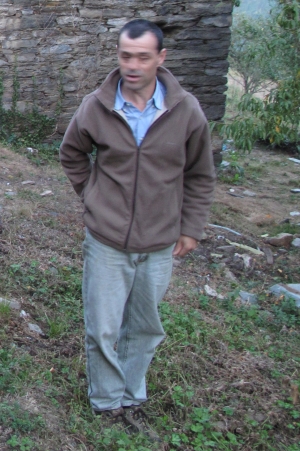
Carlos the 'Squatter'

As soon as we pulled up at the property our ‘squatter’ Carlos appeared, somewhat surprised by our unannounced incursion into his domain. I’d not managed to get a photo of Carlos during our previous encounters and spotted my chance as he talked to Amanda about all the work that he’d done on our land since we were last there (for those of you worried by Carlos in the photo I’d like to emphasis that he isn’t alien or shape-shifter, just animated at the time that I took a longer than sensible exposure).

Next Carlos’ Mum arrived, probably come to see why he’d not come home for his tea, and the usual conversation started. ‘Do you have children?’ she asked. ‘No’ replied Amanda triggering the ubiquitous pitying face. She then claimed that the house was lived-in up until five years ago. Possibly by rats, I thought, but surely not by humans.

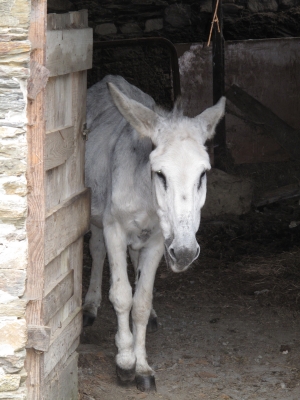
El Burro in our Barn

Before we left, I wanted to get into the barn (soon to be renamed the small house) for a quick re-orientation but found my way blocked by ‘El burro’, Carlos’ donkey who’d taken a dislike to me on our last visit. I suspect Carlos had been talking and his white donkey was guarding his home with even more menace than on the last trip.

Carlos chanced his arm and asked if he could winter his horses on our land suggesting that if we left it untended then we’d get ‘bad grass’. We suspected that ‘bad grass’ properly translated as ‘weeds’, but not wishing to take a chance, and fearful of becoming a triffid nursery before next spring, we gave our blessing.

The house was still there, Mum had been stunned into silence (which can’t be a bad thing), and the land was being well tended by Carlos and his menagerie. In the morning we were scheduled to meet the architect, everything was crossed for good news.

Posted in Background, The House in Liñeiras | Tagged , , , , | 1 Comment

The celtic connection

Being English born and bred (Mum born in Peterborough and Dad born in Epsom) I should be at my happiest walking the Pennine Way reading Shakespeare whilst eating scones with jam and cream, and singing ‘Jerusalem’ at the top of my voice. But despite expressing national pride for our oft failing sports teams, and liking a pint of fine English real ale, I’ve always been strangely drawn to all things Celtic.

From my formative early teenage years I’ve been a mad keen music fan, liking everything and anything but the Country Music genre. As well as good old mainstream hard rock (through the likes of Led Zeppelin, Genesis, Hawkwind, and Pink Floyd)  my eclectic musical collection reveals a leaning towards violins, flute, and at the extreme the bagpipes so synonymous with Celtic music. Whether it was the Pogues, Clannad or the Scottish twang of Marillion it was the Celts who got under my skin.

When I worked in Madrid in the eary 1990’s a colleague there (from Galicia) introduced me to Milladoiro the leading Galician folk band. The first listening to the crackly tapes that he lovingly prepared for me, opened up a whole new world and as soon as I got back to England I upgraded the tapes with CDs directly ordered from Green Linnet in Nashville USA, for it was the days before the Internet and e-bay.

My tipple of choice is a wee (or sometimes not so wee) Scottish Dram. I was weened onto the hard stuff after starting off sipping Drambuie from my Dads liquor cabinet, which was actually the case of an old TV set with its innards removed and a door which slid around the front to hide the contents. Each time I took a sip I took note of the pre-drink level and then topped it up with water to avoid detection. It worked a treat until one of those rare occasions when Dad decided that he’d take a drink only to find that the dark bottle contained nine parts water to one part spirit.

I have a small (30+ bottles) whisky collection, of unopened and laid away bottles. Most are rare, some are old, and all will be enjoyed at some point in the future when I have the time to do them justice.  Amanda, my brother, and anyone else who knows of my collection can’t quite understand my reticence to get stuck in. Perhaps it is a Scottish tightness?

We’ve frequently holidayed in Celtic areas. The vacations during the early years of our marriage were spend exploring Scotland, working our way up the west coast and enjoying the highlands and islands. I’ve spent time in Ireland, and as a youngster we often holidayed in Brittany. I loved all these places and felt almost ‘at home’ with the people, the food, the traditions, the music and the pace of life.

This was also how I felt the first time we visited Galicia, just under a year ago. The countryside, people, food, music and traditions all played their part in helping me to decide that this was the part of the world where I want to spend the rest of my life. Every time we go it feels like we are ‘going home’ and now that we own our two acres of it, I guess that we are.

There is some evidence that my ancestral lineage may give some justification to my sense of Celtic belonging. There are Robsons down my Mums side of the family, a traditional surname from the  north-east of England up to the Scottish borders.

Despite my leanings there is one common Celtic factor that I don’t get on with, and that’s tartan…it’s just too damn itchy!

Posted in Local Life | Tagged | 2 Comments