I’m no economist.
If I cast my mind back far enough I can just about remember that I got a grade D at A-level for Economics, only marginally better than the ‘fail’ that I got for European History. Poor Mr Metcalfe did try and help me along with my understanding of ‘supply and demand’, ‘keynsian economic theory’, and ‘economies of scale’ but I most remember him as the ‘person in authority’ who kindly signed the back of the photo included in my first British passport application.
I’ve definitely got more joy out of my passport than I’ve ever taken from economic theory. In a way Mr Metcalfe is responsible for travel around the globe over the last twenty-five years.
That said I am a bit of a closet Euro watcher. With a property in the Euro zone and the impending requirement to transfer considerable funds to our Spanish bank accounts to pay for renovation work, it is difficult not to find yourself consuming any newspaper or internet story about whether the pound sterling is getting stronger, or indeed weaker, against our fellow europeans ubiquitous coin.
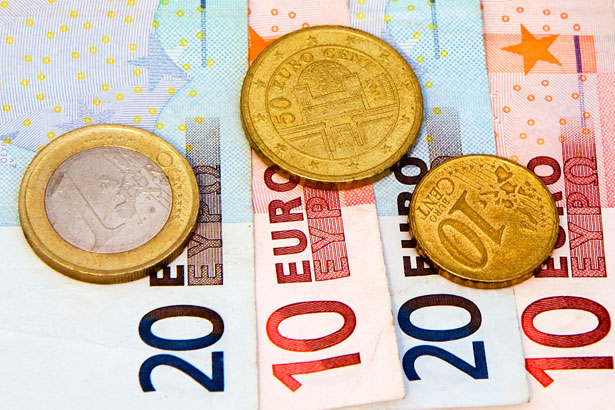
Euros by Petr Kratochvil
The ticker ‘plug-in’ on the right shows the current interbank (two to three cents above the currency exchange rate available to us mere mortals) value of the Euro against the pound. After a high in the last twelve months of 1.23560 (Euros to the Pound) it is currently trading around the 1.14 mark, which means that for £10,000 you would be getting almost €1,000 less than you would have been at its height.
Which way is the currency going? Should I buy now before sterling crashes any further? It is all a bit of a gamble. There are several trains of current thought which help to muddy the waters;
- Should UK inflation stay high then bank interest rates will inevitably increase and the pound will become a better investment, strengthening it against other currencies.
- Should Portugal, and then Spain, and then who knows who, need more economic bail-outs their bonds become increasingly worthless and once again the pound appears to be a stronger investment.
- Should the eurozone crisis (stolen link from Colin Davies Blog) continue then there is an outside chance that some countries may opt back into an independent currency with a chance to devalue themselves and become internationally more competitive. In this case the euro would likely become controlled by the Germans and its strength against Sterling would improve.
Blimey, now I’m sounding like an economist. Mr Metcalfe would be proud!